
Historic Preservation: Applicability and Action for Today
E. L. (Cindy) Kittredge
Often beginnings are quirky things. All too easily they can slip, slide away into the dust of past recollections. Ansel Adams once said, “We are living in an era of knowing the cost of everything, but the value of nothing.”
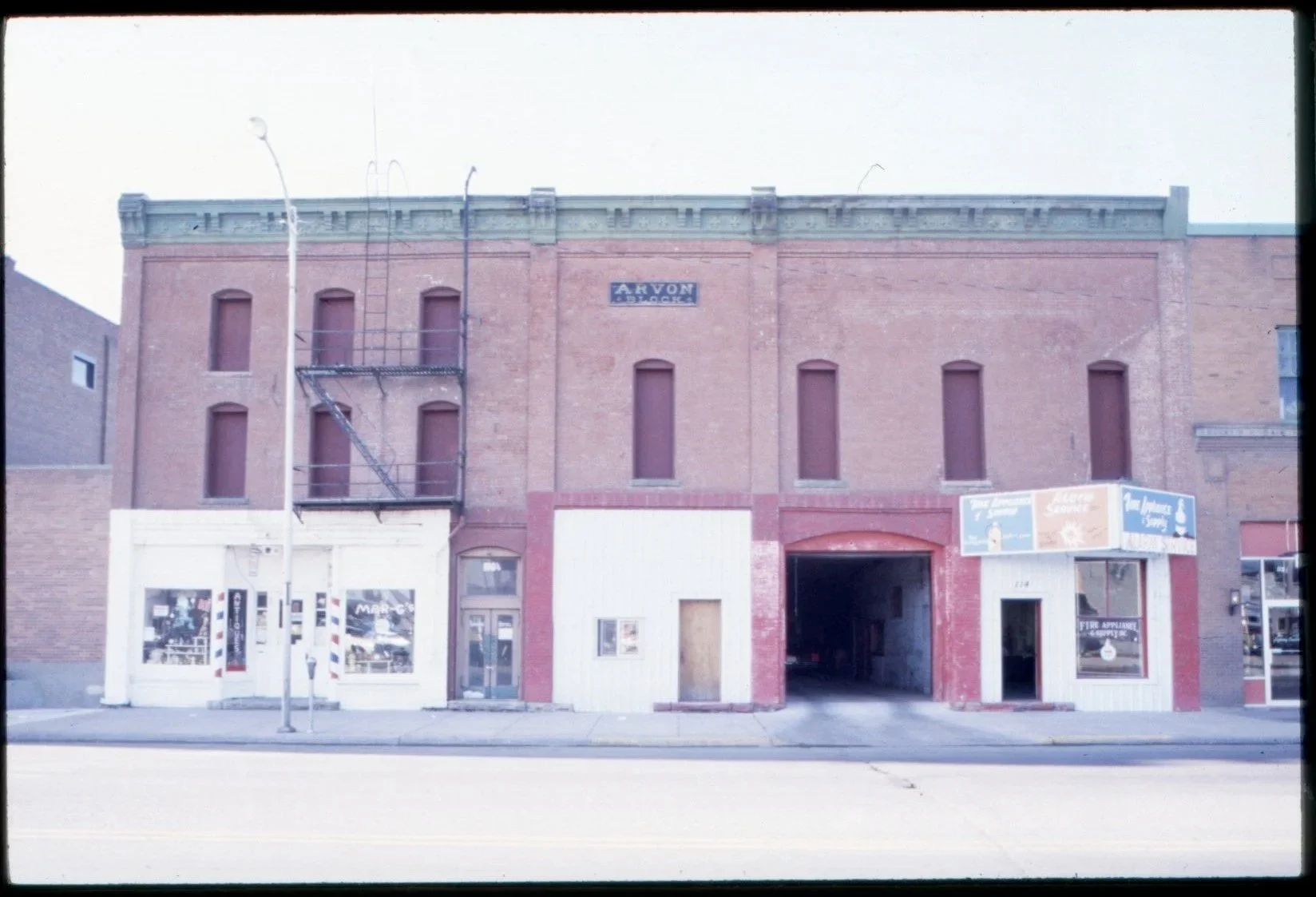
100 block of First Ave South, Arvon Block and Axtell Stables, 1979, photograph by John Staub. [CCHS 115.0462]
By 1987, residents of Great Falls, Cascade County, and even into the further reaches of the Golden Triangle had seen sections of Great Falls change through growth and gradual population loss. The demolition of the iconic “Stack” and the Opera House were only a few of the most visible.
Simultaneously, wars, neglect in tough economic times, and Time herself had made clear the need for more housing for Americans. In 1954, that push gained the description, “urban renewal.” However, with the legislative clamor for more development after WW II, evidence emerged of the demolition of buildings, lots left vacant, historic neighborhoods labeled blighted and destroyed, tangles of freeways that separated neighborhoods, and thousands of people who moved to find other places to live.
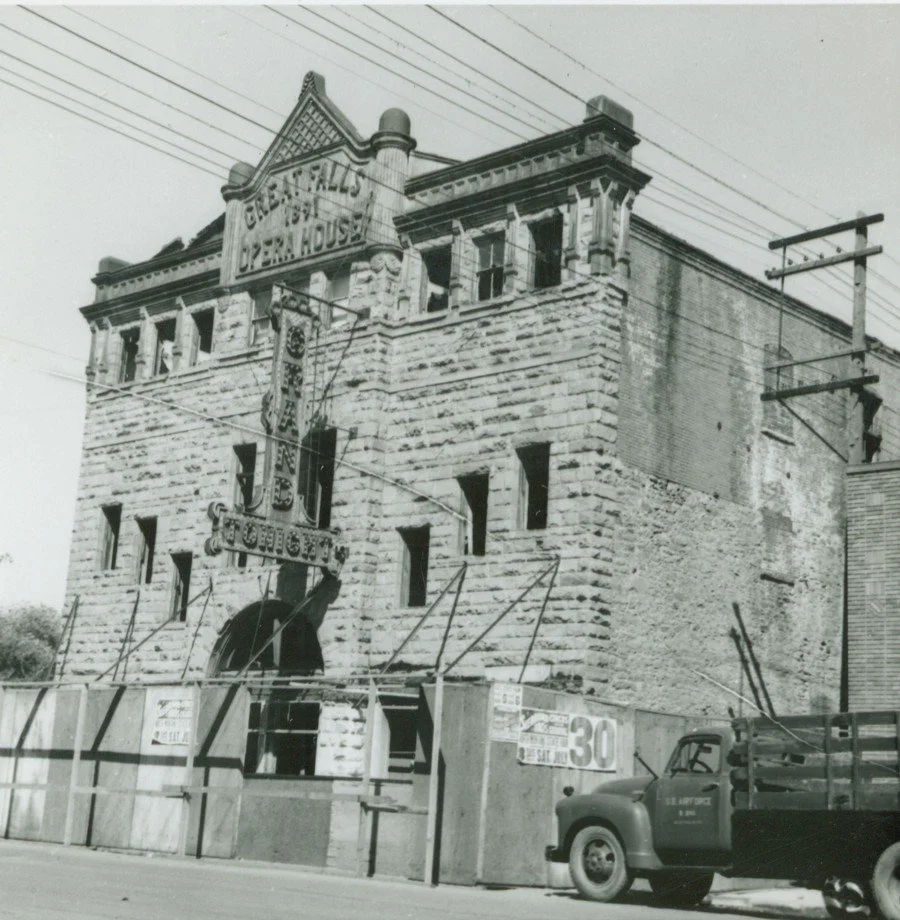
The Great Falls Opera House (3rd Street North, between 1st and 2nd Avenue North) before demolition, summer 1955. [1987.016.0011]
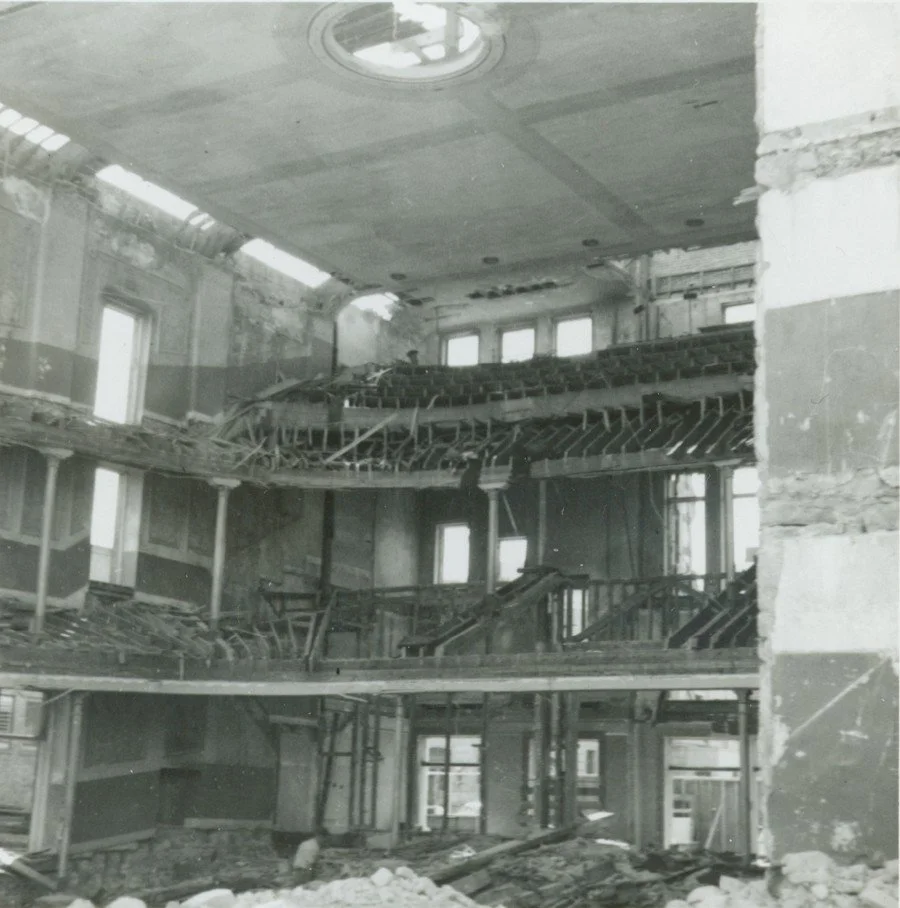
The Great Falls Opera House during demolition, summer 1955. [1987.016.0017]
To control that spread, Congress passed and signed into law (1966) the National Historic Preservation Act. Its purpose was to establish a network of all states and tribes to help recognize and document significant historic resources. With that came the hope of preserving and limiting what the grassroots considered “rampant development.” The information gathered was meant to ensure that historic properties be considered in future planning.
Here, I need to mention the often debated word “preserve” and why I linked a museum’s work to the process of recording what many consider a fungible asset, real estate. The words “preserve” and “preservation,” had a Latin birth, but came to us through Old French, where the words described the action “to save from an evil that might happen.”
That means that a preservationist isn’t an obstructionist preventing any application of new ideas or someone living in the past, or even a person blocking an area’s development dreams. As I wrote in 1988, preservationists “are merely trying to ensure that the rich heritage of the past is still in place for future generations.” A visible, current example of the need to enforce such a law would have been to stop the demolition of the east wing of the people’s house, the White House.
“Could’ves” or “should’ves” aside, the point is that to preserve is not a negative force. In most cases it slows or delays to allow for needed consideration. Whether preserving involves jams and jellies, a cache of coins in a piggy bank, a cherished object packed away, or a sacred ceremony, preserving allows the time for deciding and choosing. The word can apply to how we Montanans view the spaces around us, a plot of land that holds special memories, or a building we went to school in. And, incidentally, all carry the expectation of care and conserving something deemed valuable and irretrievable.
When I moved back to Montana, from having gone to school, lived, and worked across the U.S., I saw the state on the edge of a coming wave of change. Some landmarks, like The Stack were gone, and blocks where houses had stood were bare.
Some buildings like Paris Gibson were not recognizable even though my mom had driven me once a week to piano lessons at Ms. Calvert’s house across the street. I didn’t recognize the statuesque stone building minus the failing addition demolished during the movie “Telefon.” Nor did I know that a historical society lay tucked in a far corner of the building, beginning to shape a museum.
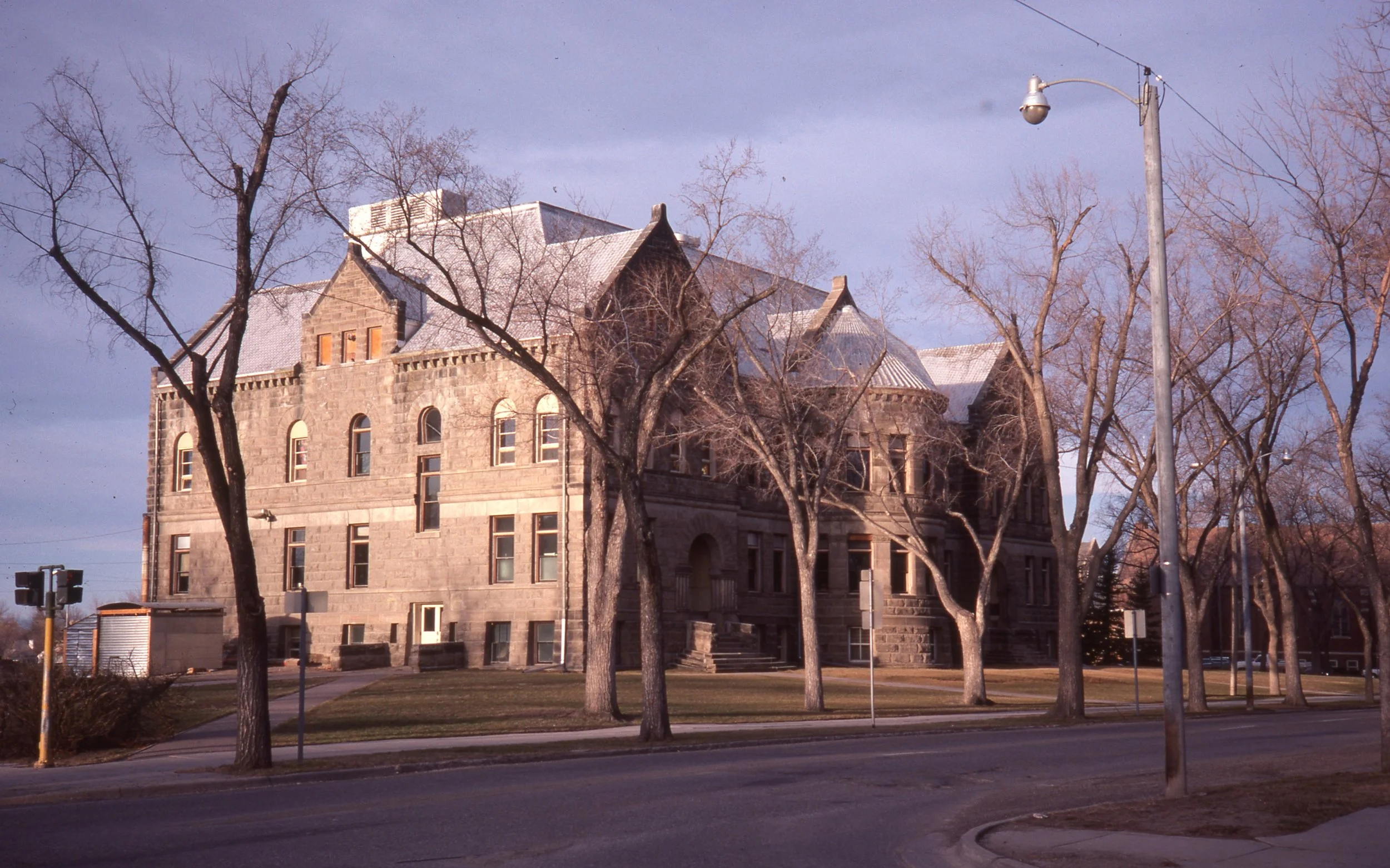
Paris Gibson Square, 1977, photograph by John Staub. [2025.035]
The evening after my first day of work at the Cascade County Historical Society, I asked myself where to start! In May 1987, CCHS had hired Mary Melander to research the original homestead patents for the area. That information would, in the coming year, document the locations of homestead sites, proof of how agriculture was a key historical thread.
The information of over seven thousand agricultural patents in Cascade County alone would provide the basis over the next year for two exhibits that CCHS mounted, one at Paris Gibson Square and the other at the CM Russell Museum. Those exhibits put history on display, provided a key component for not just learning about the past but for building an appreciation for it. For many, those exhibits provided immediate and personal reminders, forces from everyday life.
In 1987, Montana’s State Historic Preservation Office was located in Helena near where the office currently is in the new Montana Heritage Center. When the Cascade County Historical Society hired me, Montana’s SHPO officer was Marcella Sherfy Walters, a historian in the field of architectural history. I had met her during a week-long intensive American Association of State and Local History workshop. In that fertile ground, the seeds of more active preservation work in Central Montana grew. And with much broader strokes than I even imagined.
In early 1988, when I called Ms. Walters with my idea to initiate an effort to form a local historic preservation office, she didn’t sound too hopeful for success in the town that I had overheard some call “Demolition Central.” She added that knowledgeable individuals had met little enthusiasm for the idea.
What I heard made me realize that this effort called for what experience had taught me -- the effectiveness of a “stepped approach,” in which small steps accrue and make progress toward a desired goal. I still find it more effective than the “dripping faucet” routine which runs the risk of becoming only an irritant.
I also knew that beyond research, documentation, and creating a record, the community needed interested residents to learn more about the guts of preservation work, what makes it such a compelling force in a community, not just for learning, but for the economics of living. It simply makes sense.
Ellen Sievert and her husband, architect Ken Sievert already had indicated their interest in the built heritage. Also, Candi Zion, a Great Falls native, had just graduated in Public History/Historic Preservation from Arizona State University and was already researching and documenting a Northside Residential Historic District. The three would make a most knowledgeable corps with whom to travel this path.
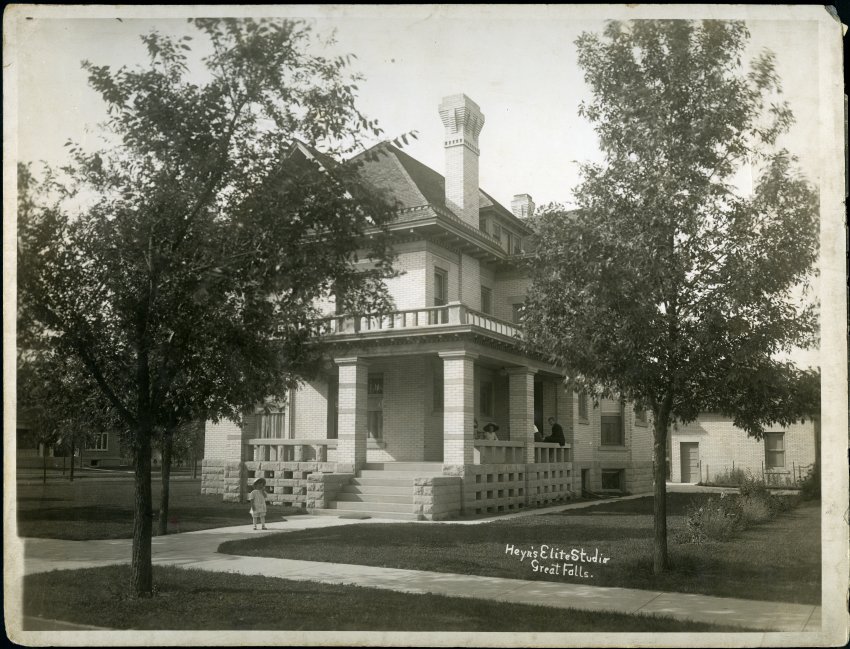
Jensen Home at 207 3rd Ave N in the historic Lower Northside Residential District in Great Falls. [2024.043.0023]
However, I also knew that other people with other interests needed to be enlisted. Foremost, a common myth had to be dispelled – that historic preservation work of our built heritage was far more than a planning a tool for housing. In all its richness of telling our communities’ stories it needed to venture beyond the myth that history only applies to the rich and famous. In the on-going tasks ahead, all kinds of interests and backgrounds and knowledge would be needed in the work of the future.
And so, I did what everyone said not to do.
I called for an appointment to see the city manager, at the time, a man who all said would without pause say “No!” By the time I started to launch into my second sentence in asking for Great Falls to establish a Historic Preservation Advisory Commission, he agreed to the idea. By early spring of 1990, the Great Falls City Commissioners unanimously had passed the ordinance that created a historic advisory committee for the city.
By January 1989, Ellen Sievert had completed her work on a survey of the Great Falls fairgrounds, that garnered a national registered district designation – the Northern Montana Fairgrounds Historic District. The Lower Northside Residential district gained National Register status in April 1991, and the Commercial Central Avenue Business Historic District gained its status in March 2001. More recently, a Railroad District as well as a Prairie Bungalow District have received recognition.
In 1991, there seemed to be a sense of the coming growth and urban spread into the county’s rural edges, and the city and county formed a joint Historical Preservation Advisory Commission. That group of nine interested people would help in the coming years to provide “standing” to what the Cascade County Historical Society would take on in sheltering and encouraging new ways of seeing and honoring our heritage.
Great Falls/Cascade County Historic Preservation Advisory Commission Logo, designed by Sheree Nelson. Adopted 2016.
The awareness that had developed in the community with the research and recognition of key historic districts helped to build momentum. In early 1990, Stan Meyer, chair of the Great Falls Chamber of Commerce Visitors’ Bureau, and Dirk Larsen, from the High Noon Optimists, approached CCHS to help with the gathering interest in preserving what was then called the Ulm Pishkun. With the Board endorsement, CCHS became involved in the advocacy and development of that project’s archaeological research, conservation, and educational development. In 1999, that park celebrated the grand opening of a new interpretive center that both provides educational value for the public, while also securing the resource.
In 1994-1995, aware of the thrust of the First People’s Buffalo Jump State Park, the recognition of the historic districts, and ties to CCHS, Arlyne Reichert, who would become known as “the Bridge Lady,” contacted CCHS for its support and help save the 10th Street Bridge. She wanted help in forming and developing an advocacy group to prevent the demolition of the historic bridge.
Later in 1995, in a “Hands Across the Bridge” effort, Preservation Week brought together CCHS, the CM Russell Museum, Paris Gibson Square Museum of Art, the Ursuline Centre, Trinitas Gallery, the Great Falls Public Library, Lewis and Clark Portage Route Chapter, the Lewis and Clark Interpretive Association, Montana Fish Wildlife and Parks, Great Falls Public Schools, and the River’s Edge Trail.
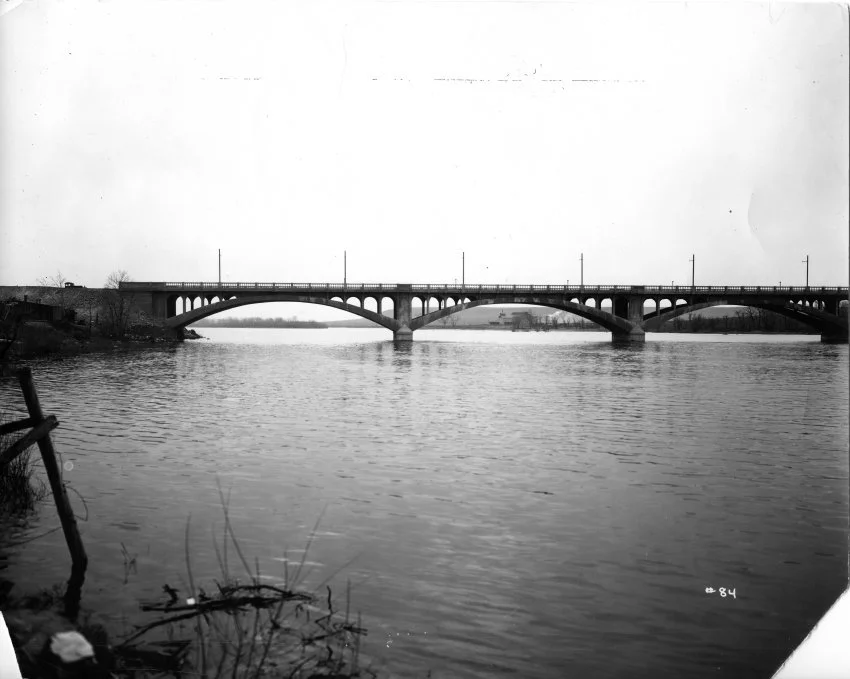
10th Street Bridge in Great Falls, MT, 1920s. [1990.026.0001]
By 2002, an advocacy group, Preservation Cascade, had formed to focus on saving 10th Street Bridge which in 2022 was renamed the Arlyne Reichert Community Heritage Bridge, aka the ARCH Bridge. That effort raised more than one million dollars to restore the bridge as a pedestrian pathway.
Several points emerge from this rather long “brief” blog. Most obvious is that an effective network requires more than one person or group.
That point also helps as we adjust perspectives, sometimes an easy task and at other times, painful.
In that, we can’t forget that just as we expect to be treated, our pasts, the memories and the reminders deserve similar attention and care.
And last, but not least, as part of a chain into the future, it is our responsibility to learn more about preservation, to become more active in saving the few pieces that have survived and to teach others how to conserve the past as we appreciate it, moving forward.
Therein lies the value.
Ansel Adams’ words seem applicable today, even as we make our way in a century quite different from his.
Editor’s Note:
E. L. (Cindy) Kittredge, director of the Cascade County Historical Society (CCHS) (1987-2004), was instrumental in assisting the formation of the Great Falls Historic Preservation Advisory Commission (HPAC) in 1988 with the purpose of promoting the preservation of historic and prehistoric sites within the city. With Kittredge’s urging, the City of Great Falls and Cascade County combined their efforts to form the City/County HPAC in May of 1990, and Kittredge was appointed the Historic Preservation Officer (HPO) with the office based out of CCHS in the Paris Gibson Square building. Kittredge held the position of City County HPO until 1999.
More informaiton about HPAC can be found here