
Jump into the Past: A History of the First Peoples Buffalo Jump
We are lucky to have First Peoples Buffalo Jump State Park in our backyard! Please remember that the jump is protected by state law. Do not disturb anything or collect anything from the area.
The state park has a history that is intertwined with the Cascade County Historical Society starting in 1990. But to set the stage for that collaboration, we begin one hundred years earlier. First Peoples Buffalo Jump State Park was known as Taft Hill in the late 1800s. The State of Montana acquired 320 acres of the section that includes the main buffalo jump and early state park in 1899. However, that did not stop sandstone quarrying occurring in the area into the early 1900s. Foundations for many buildings in Great Falls and Helena were built from the sandstone from Taft Hill. The buffalo jump also was targeted for bone mining from 1945 to 1947. Maynard Shumate of Cascade, Montana, a well-respected avocational archaeologist, witnessed bone mining operations at Taft Hill in the 1940s. The bison bone was used for bone meal fertilizer and approximately 150 tons of bone were removed from an area along the cliff face. Some bone mined from buffalo jumps also was used for munitions during World War II.
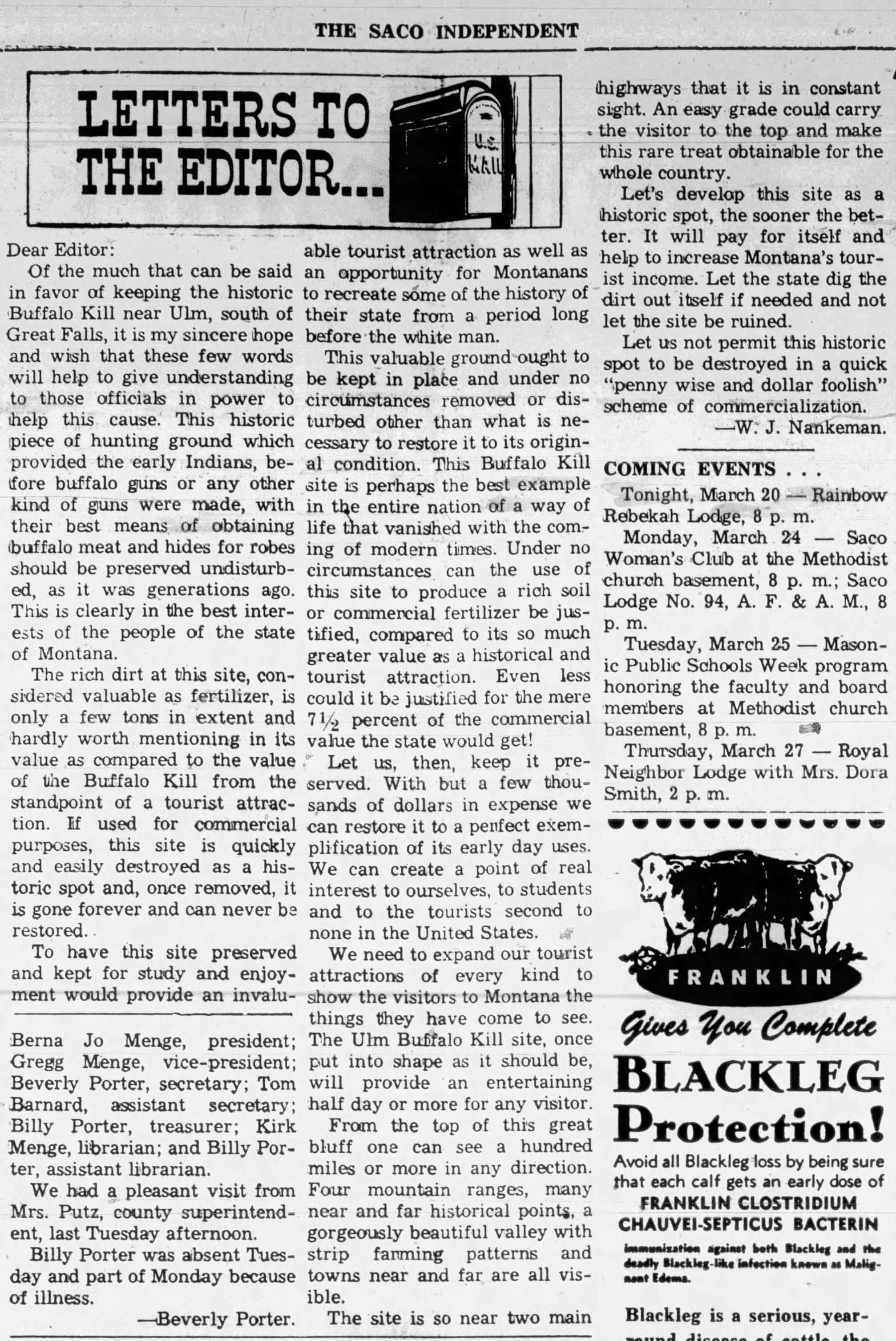
Letter to the Editor in the Saco Independent newspaper, March 20, 1958
After the war, in January 1958, James A. Cave requested a lease of the state land for bone mining for fertilizer. The History Group of the Montana Institute of the Arts (MIA) protested to the State Board of Lands and Investments. Larry Gill, chairman of the MIA History Group and Dr. Dee C. Taylor, Montana State University (University of Montana now) anthropologist, stated that this buffalo jump could be one of the deepest and oldest known (Great Falls Tribune January 15, 1958). The protests against this bone mining lease were voiced across the state, even a letter to the editor in the Saco Independent newspaper in Phillips County notes that this buffalo jump could be an important tourist attraction. Earl Munroe, a local rancher, leased the land and made it off limits to mining and looting. The MIA History Group took on the idea of a state park. Other groups were solicited to help, such as the Ad Club, Rotary, and the Montana Pilots Association. Additionally, Dr. Carling Malouf, chair of the archaeology department at Montana State University (University of Montana now), spoke to the Great Falls Arrowhead and Mineral Club and recommended the site as a state monument. Sadly, Ulm Pishkun State Park was not to be at that time.
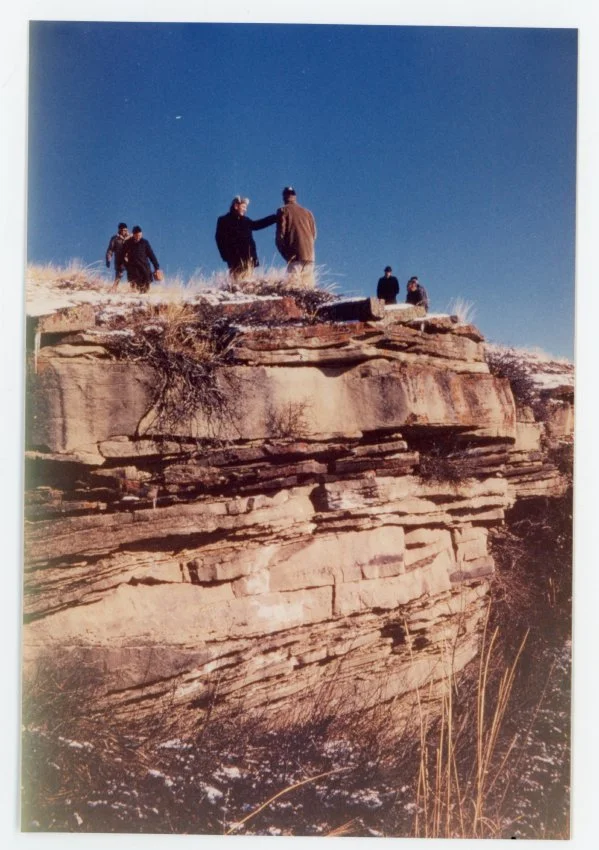
February 1968 visit by representatives of state agencies and civic groups [1992.015.0016]
Another push for a state park was championed by the Nature and Wildlife Society, Great Falls affiliate in 1968. The Ulm Pishkun State Park Development Committee consisted of Margaret Adams, Norma Ashby (KRTV), Dale Brandt, Olga Dawson, Roger Fliger, Dick Hunsaker, Roger Larson, William L. McLaughlin, Harry Mitchell (Ayrshire Dairy), Earl Munroe, Don Osburn, John Reichel, Maynard Shumate, Mrs. William Wenzel, Ed White, Wes Woodgerd (Fish and Game Department), and Lt. Randy Ziegler. Meetings were held with the State Park Department along with two adjacent private land owners, from which the group desired to acquire land to be included in the state park. The land owners, Mrs. Anna Stephen and Mr. W.C. Eustance, wanted further consideration of the proposals and to speak with the State Land Board. The park was in a “state of uncertainty.”
In the early 1970s, the state land lease was obtained by the Montana Historical Society, which transferred it to Fish, Wildlife, and Parks. In 1972, Ulm Pishkin finally became a state park and was designated as a state monument. The archaeological site was listed on the National Register of Historic Places in 1974. The 160 acre tract had minimal facilities and interpretation, but it was now protected as a state park. In the 1980s, the Hi-Noon Optimists Club kept up the existing visitor facilities on a volunteer basis. They contributed substantial time and money to maintain the interpretive signs and picnic facilities through a committee headed by Dirk Larsen.
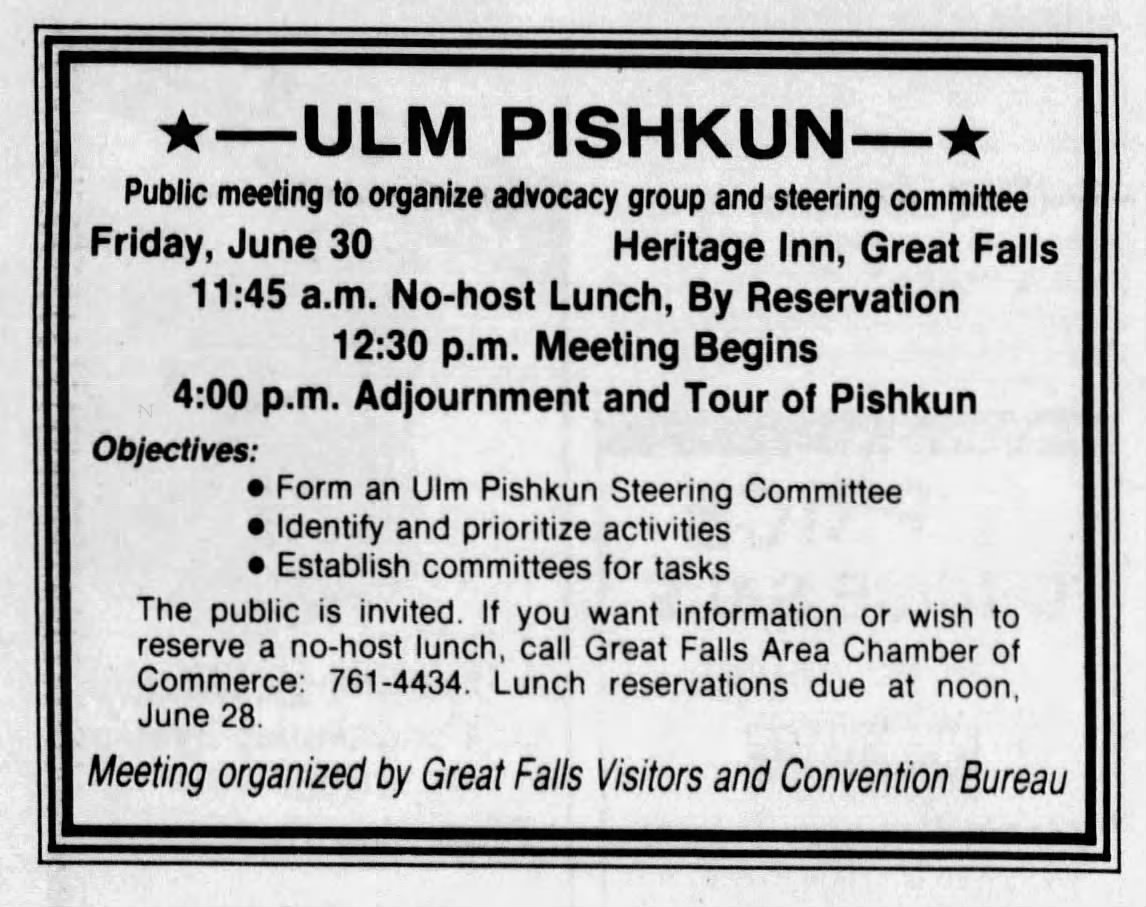
Newspaper advertisement for the Ulm Pishkun Support Group, Great Falls Tribune June 27, 1989
In 1988, a group of concerned citizens formed the Ulm Pishkun Support Group. They lobbied the state to expand the park. The group included the Great Falls Visitors Bureau and the Great Falls Area Chamber of Commerce. Inquiries were made with Dr. Les Davis at Montana State University – Bozeman about the archaeological data for the buffalo jump and joining the support group. Dr. Davis emphasized that there only had been limited archaeological investigations of the site. This was reiterated by other both Dr. Tom Foor (University of Montana) and Steve Aaberg (Montana State University).
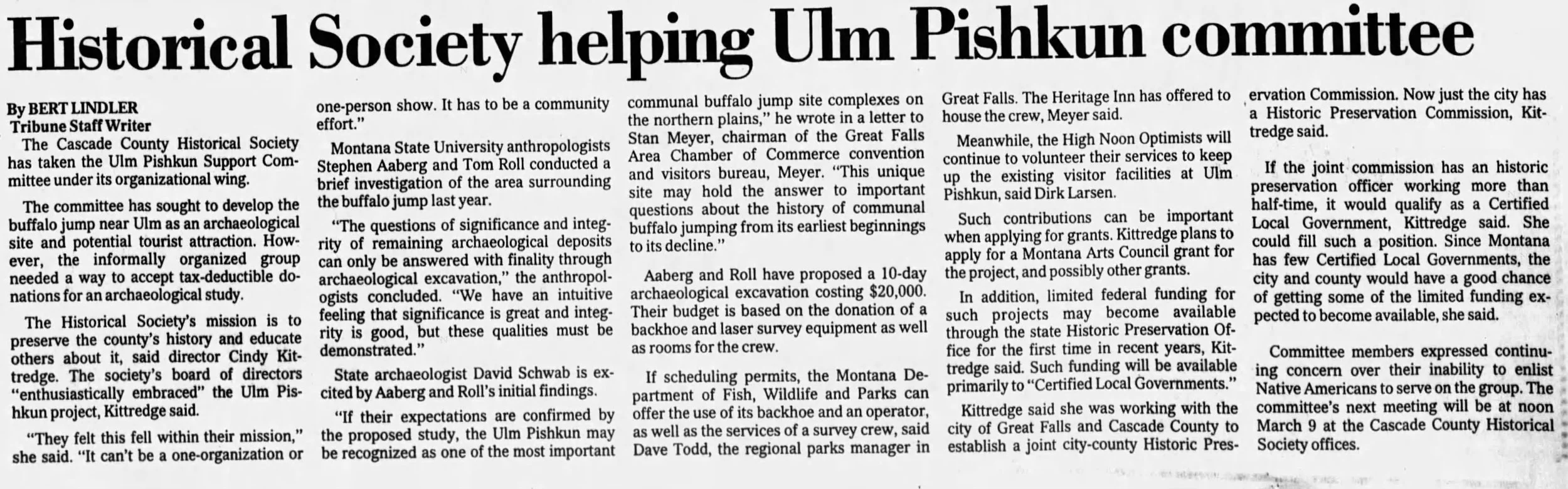
Article announcing the partnership between the Cascade County Historical Society and the Ulm Pishkun Support Committee, Great Falls Tribune February 18, 1990
This is where the Cascade County Historical Society joins the story. By 1990, the historical society had taken the Ulm Pishkun Support Committee under its wing (Great Falls Tribune February 18, 1990). Many efforts were made to include indigenous people in the support committee. The affiliation with the Cascade County Historical Society provided additional credibility, nonprofit status, structure, and skilled personnel to prepare grant requests. The immediate objective was to raise funds for research by Montana State University archaeologists. This led to the first “Evening Atop the Pishkun” fundraiser. In 1991, the Cascade County Historical Society opened an exhibit called “Utility of the Spirit: Seeking the Buffalo Person” (developed by Peter Jennings, curatorial assistant) with a Native American art show and silent auction. There were several fundraisers and numerous donors to this worthy cause.
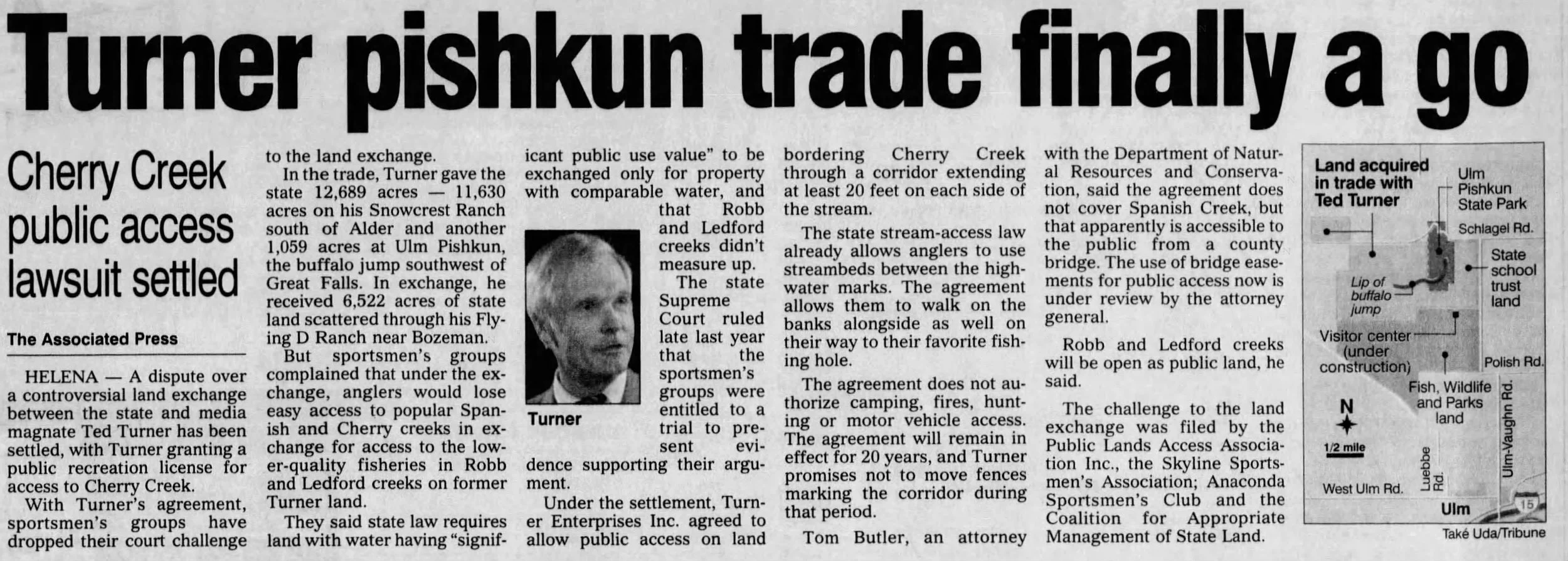
Article discussing the controversy around the Turner land exchange, Great Falls Tribune August 28, 1998
By 1992, the support committee and Montana Fish, Wildlife, and Parks had worked with Ted Turner, cable television pioneer and owner of the Flying D Ranch near Bozeman, for a series of land exchanges and purchase agreements to expand the state park to just over 1,400 acres. These exchanges with Ted Turner were controversial and were not finalized until 1998. Turner said he pursued the purchase because “an important historic site like this should be preserved for future generations” (Great Falls Tribune March 7, 1992). The Turner Foundation continued to support the efforts at Ulm Pishkin.
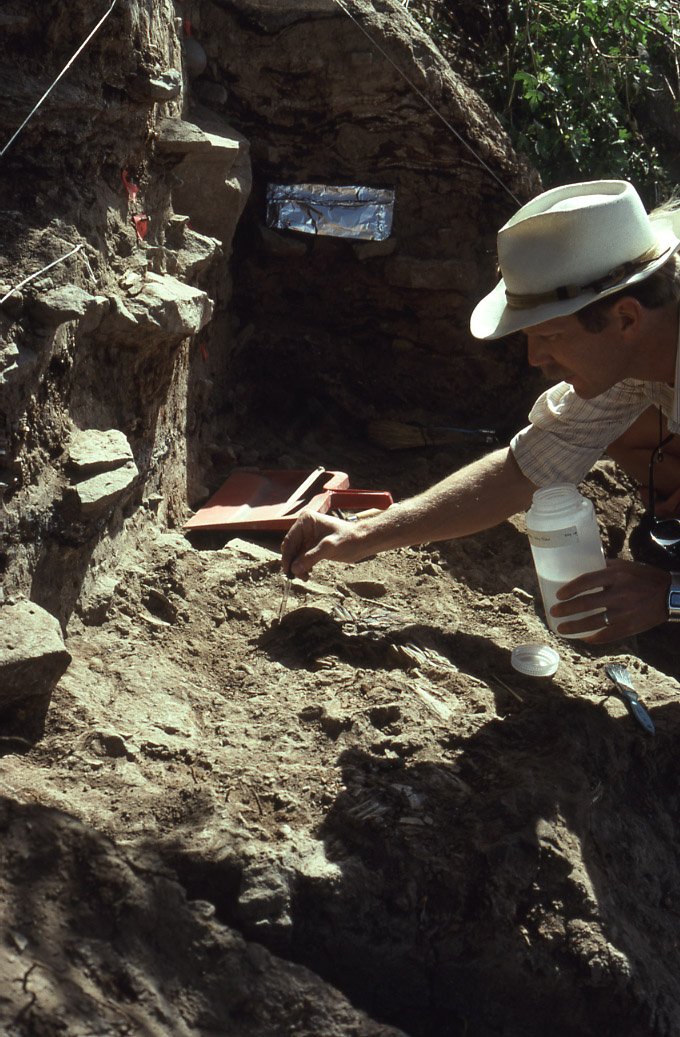
1992 Montana State University excavations, Dr. Jack Fisher. Photo courtesy of Montana Fish, Wildlife, and Parks, First Peoples State Park.
In the summers of 1992, 1993, and 1995 Montana State University archaeologists, Dr. Tom Roll and Dr. Jack Fisher led excavations at the buffalo jump. These excavations revealed that the site deposits are deep, extending up to six feet below the surface. They found that a number of buffalo jumping events occurred at the site from 1,000 to 250 years ago. When the volume of bone removed by the bone mining is included, it is estimated that over 10,000 bison were killed at the site through time. However, the total number of bison killed at the main kill location is likely in the tens of thousands and other evidence shows that the buffalo jump was used up to 6,000 years ago. Now the scientific data were available for better interpretation of this significant buffalo jump. This information also was incorporated into teaching curriculum. In 1992, the Cascade County Historical Society received a grant from the Montana Committee for the Humanities to take a curriculum about the Ulm Pishkun buffalo jump into the public school system and also led a teacher workshop in 1993 focused on the buffalo jump.
The name of the group evolved through time and the Ulm Pishkun Preservation Committee included names that had been championing the buffalo jump for decades, such as Harry Mitchell and Margaret Adams from the 1968 group. In 1994, a charrette was conducted to aid planning efforts for the visitor center and interpretation. This eventually led to the location of the visitor center below the jump, which allows for a visual connection but does not disrupt the site. Some money for the visitor center planning and construction was appropriated in the 1995 state legislature and both a park advisory committee and a Native American advisory board were formed by 1996.
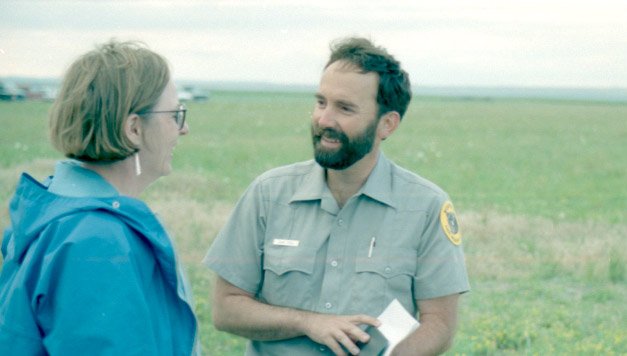
Evening at the Pishkun Fundraiser – Cindy Kittredge and Dave Todd [2020.006.0244-13]
More funds were raised with events like “Evening at the Pishkun” with a performance by singer and storyteller Jack Gladstone (July 10, 1997). Artist King Kuka also contributed a sculpture titled “Dawn of the Hunt…A Blessing” in 1994 to assist in raising funds. A draft visitor’s center design package was received at the end of 1997. The dedication of the visitor's center site was on April 4th, 1998. The Ulm Pishkun Committee as of 1999, included Margaret Adams, Susan Calvin, Wade Crouch, Deb Hanson, Candy Helms, Gracia Hilde, Mike Labriola, Dirk Larsen, Stan Meyer, Harry Mitchell, Michael Morrison, Becky Roberts, JoAnn Roach, Dan Smith, Dave Todd, Margaret Towne, and Sandy Wallace. This steadfast group saw their efforts come to fruition with the visitor center grand opening on June 5, 1999. The Cascade County Historical Society and Paris Gibson Square Museum of Art developed an exhibition titled “Unfettered Spirit: Art and History on the Open Plain” to complement the Ulm Pishkun Visitor Center construction and opening.
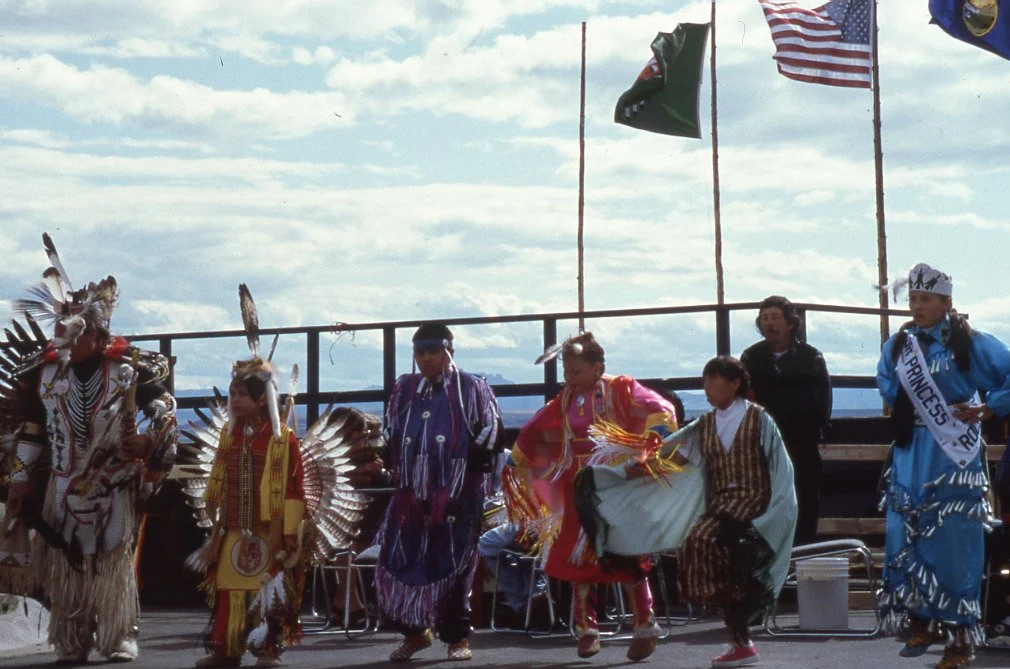
Visitor Center opening day June 5, 1999. Photo courtesy of Montana Fish, Wildlife, and Parks, First Peoples State Park.
The historical society’s involvement continued with Cindy Kittredge serving as a member on the Ulm Pishkun State Park Advisory Committee: Mary Anne Cosgrove – Skyline High School, Gayle Fisher – Russell Country, Jack Fisher – Montana State University archaeologist, Brad Hamlett – All Nations Pishkun Association, Ed Hastings – Park neighbor, Lyle Heavyrunner – Blackfeet Tribe, Chuck Niswanger – Quigley’s Quickstop, Cindy Kittredge – High Plains Heritage Center (Cascade County Historical Society), Faith Roberston – Ulm Pishkun State Park Lead Park Ranger, and Fay Schaller – Montana Native Plants Society. This group developed the park management plan in 2005. Over time, foot trails, new interpretation, and a new parking area on top of the jump were put in place. In 2007, the state park received a new name, First Peoples Buffalo Jump State Park. An additional 427 acres were added to the park in 2008 bring the total area to 1,906 acres. Another important recognition of the site was gaining National Historic Landmark status in 2015. The State Parks staff have continued to be good stewards of this important site.
- Connie Constan, Executive Director
Acknowledgments:
The number of people on committees and overall supporters for the last six decades is astounding. So many people and businesses cared and contributed time and money to First Peoples Buffalo Jump! I couldn’t include them all. From Montana Fish, Wildlife, and Parks, Dave Todd and Dan Smith stayed the course developing this state park into an important tourist destination. They even hired me as a young archaeologist in the role of park interpreter the summer the visitor center opened. I witnessed the first season of visitors to the new Ulm Pishkun Visitor Center in 1999. Wided-eyed kids, happy families, foreign tourists, and curious locals all came through the doors. Now I am at The History Museum & Research Center reflecting back on how interconnected we all are as we preserve our history for the future.
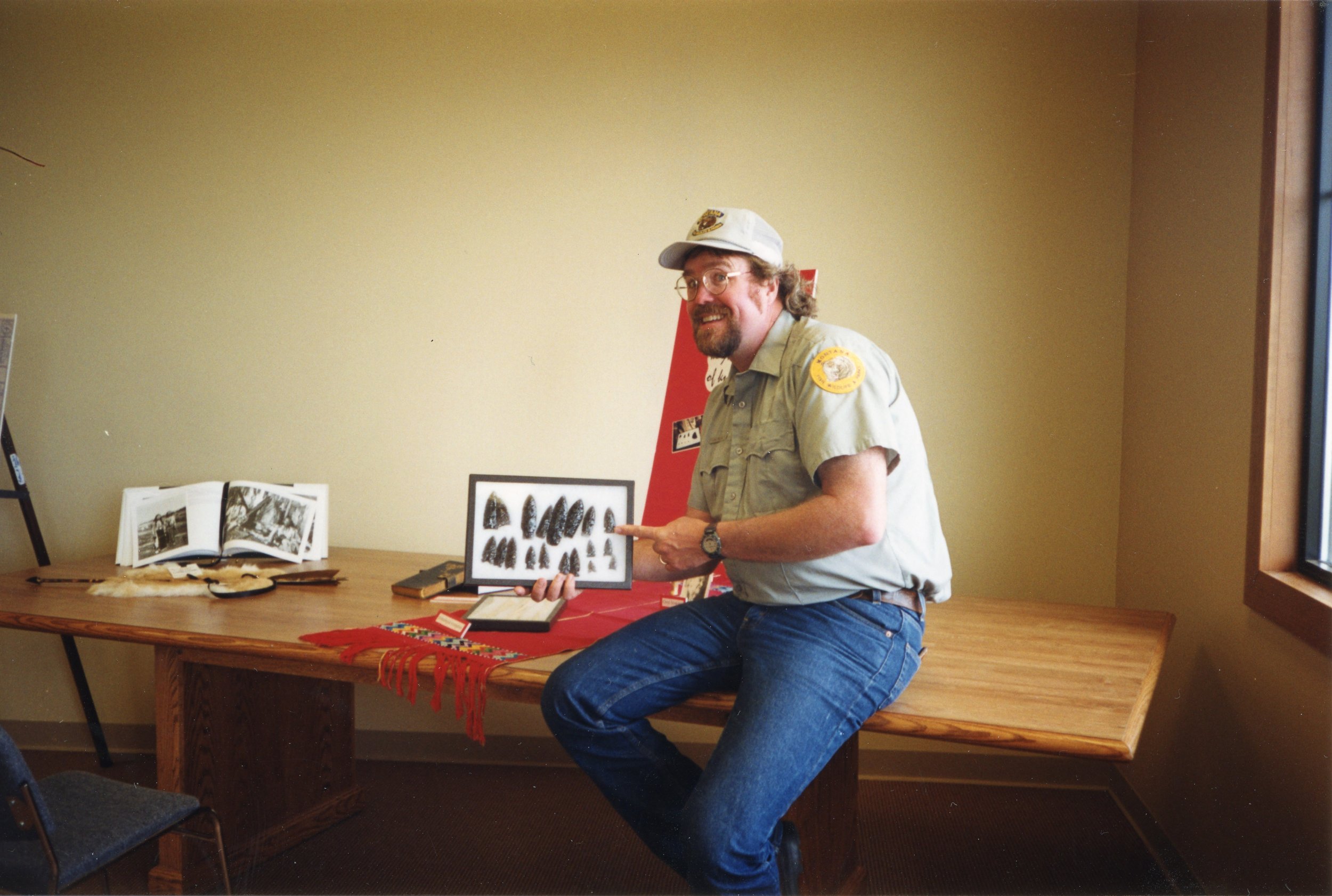
Dan Smith, photo by Connie Constan, Ulm Pishkun Visitor Center Opening, June 5, 1999