
How the Cascade County Historical Society Began
Clara Heffern
Note:
2026 marks the 50th anniversary of the Cascade County Historical Society, and as part of that we looked back into our beginning for our January 2026 blog post. Below, Clara Heffern (1910-2005) wrote down how it all began. She was the first director of the society (1976-1980) which was a volunteer position when it began.
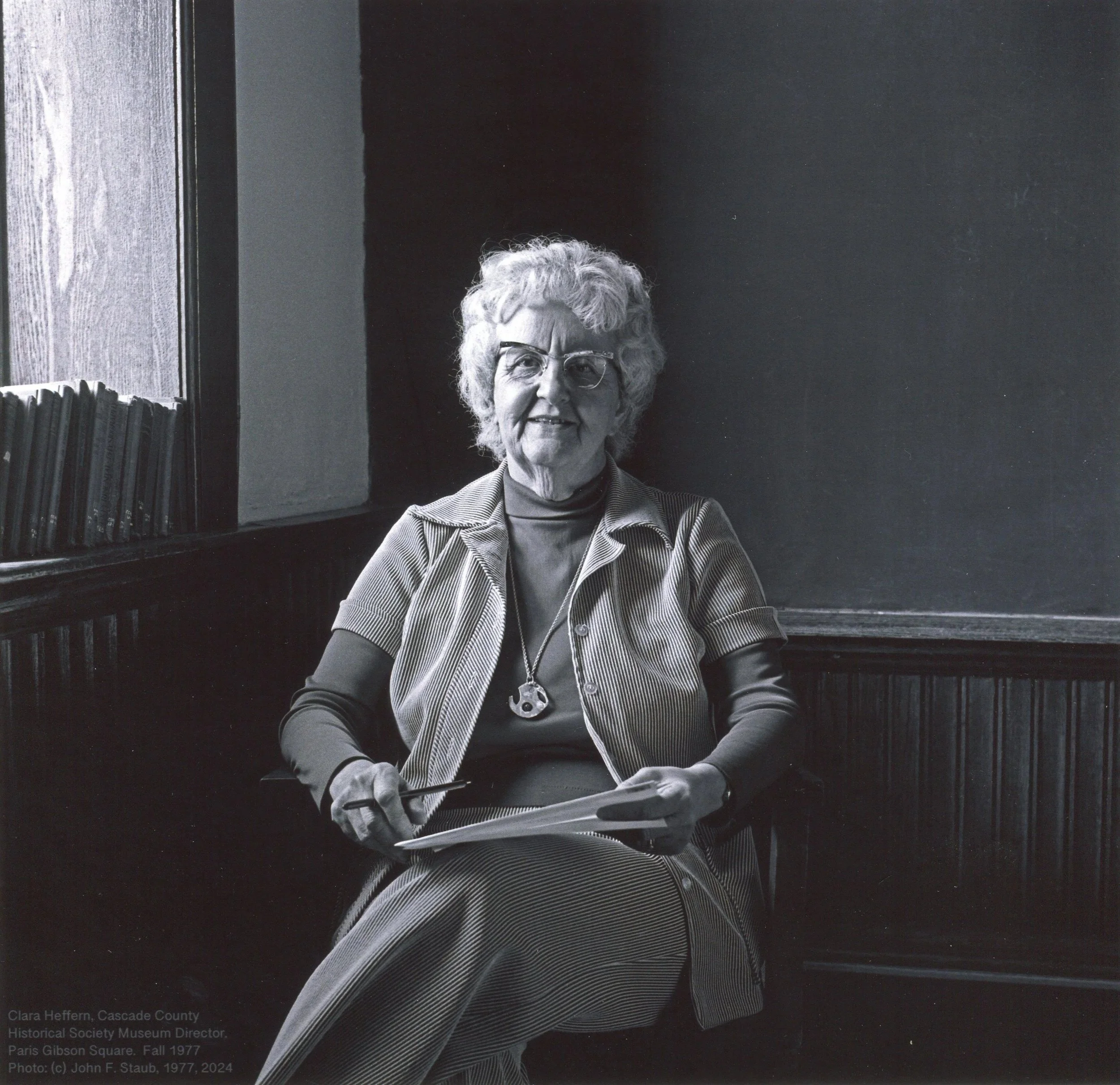
Clara Heffern, Cascade County Historical Society Museum Director, 1977-78, photo by John Staub. [2025.035]
I could start by saying that the Cascade County Historical Society began with the first meeting in my home on January 8, 1976 – which is true – but doesn’t give you a clue about the reasons for organizing or the origin of our involvement with Paris Gibson Square.
It seems that I have been delegated to put that information together as the result of having served on the Boards of both organizations from their inception.
Some of you may recall that back in May of 1975, the Citizens Involvement Committee sponsored a workshop called From Planning To Action.
I mention this because it was the beginning of my personal involvement and also the beginning of the task force that eventually evolved into Paris Gibson Square and Cascade County Historical Society.
During the first day of this work shop – about four hundred people who had been invited to participate – worked on defining Images and Goals For Our Community and we listed everything from bridges across the Missouri to saving the old Paris Gibson Junior High School Building, originally the old High School, with many things in between, as being possible good projects for Great Falls.
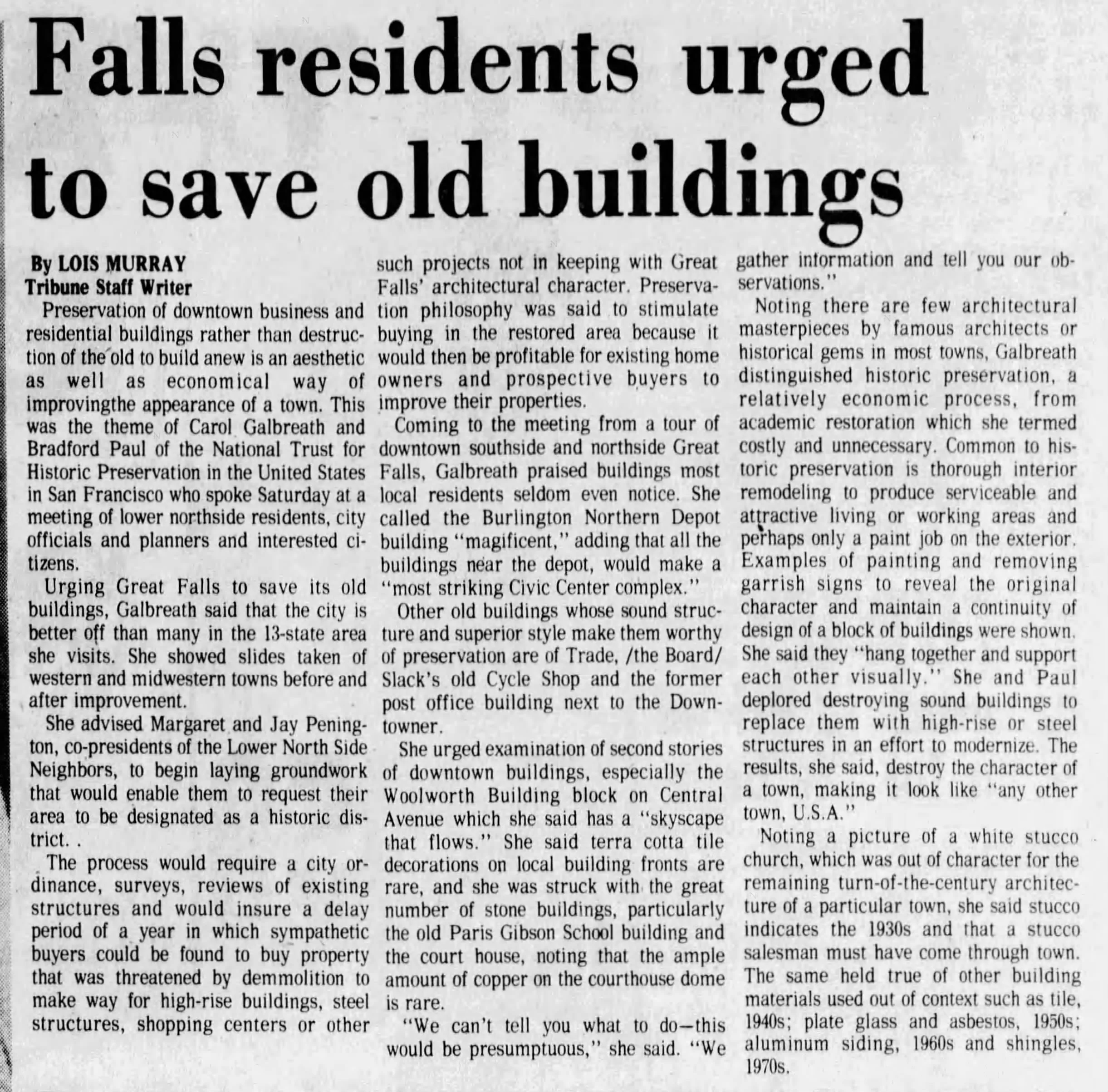
Clipping of “Falls Residents urged to save old buildings,” Great Falls Tribune November 23, 1975.
The second day we worked on Strategies For Action, and by the time the workshop ended most of us were committed to work on one of these projects. By this time the major goals had been defined and those which were related in some way were grouped together. I ended up in the Save Paris Gibson Group.
Remember the date here. It was the spring of 1975 and the entire country was being drawn into celebrating the Bicentennial. All over, people were planning special activities, parades, town meetings, putting together their state and local histoires and starting historical societies and museums where they didn’t already have one.
1975 was also the year that Paris Gibson Junior High School was being moved east on Central Ave into the building formerly known as Central Catholic High School, and people were wondering what would become of the old building.
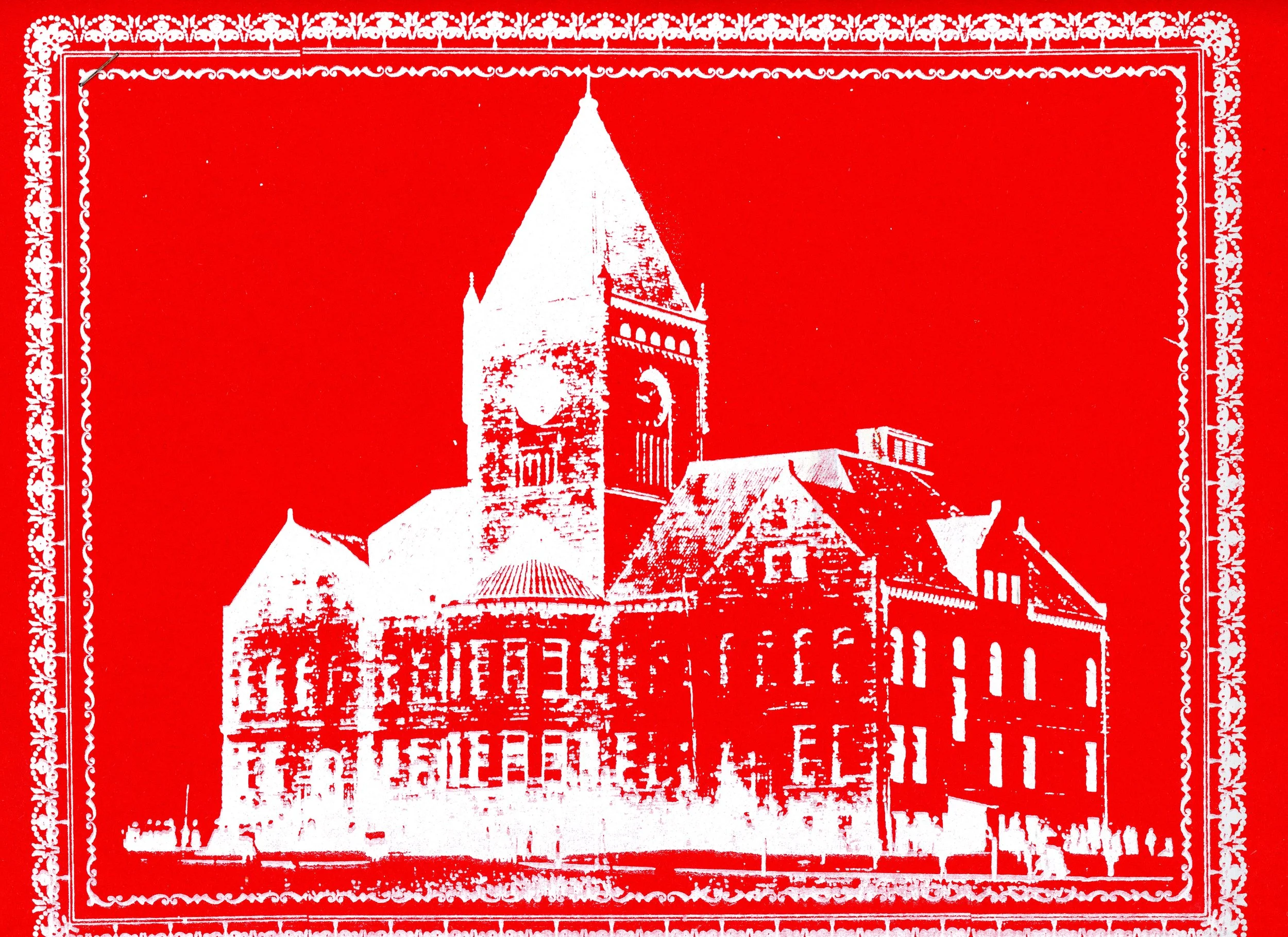
Cover of the “Goodbye to the Old Paris Gibson Junior High School” program by the Cascade County Bicentennial Committee, May 27, 1975. [2014.012.0002]
Great Falls didn’t have a museum or a society for local or county history and it seemed to me that this was the time and the place to begin one. Of all the goals suggested, this was the one I thought I could best work on.
Developing a Heritage Park at Giant Springs, another goal discussed, would also have been a possible place for a museum but the feasibility of a suitable building there was a long way off.
Getting back to the Save Paris Gibson table at the workshop, I found that the people there had varied ideas. Some just wanted the building preserved. Others were interested in it for various specific uses, some organizations looking for meeting places, others for commercial purposes. The largest representation was from people involved in different aspects of the Arts. I later learned they were members of a group called the Great Falls Arts Council. They were the steering group.
When the workshop ended, we participants were assured that someone would soon be calling each of us.
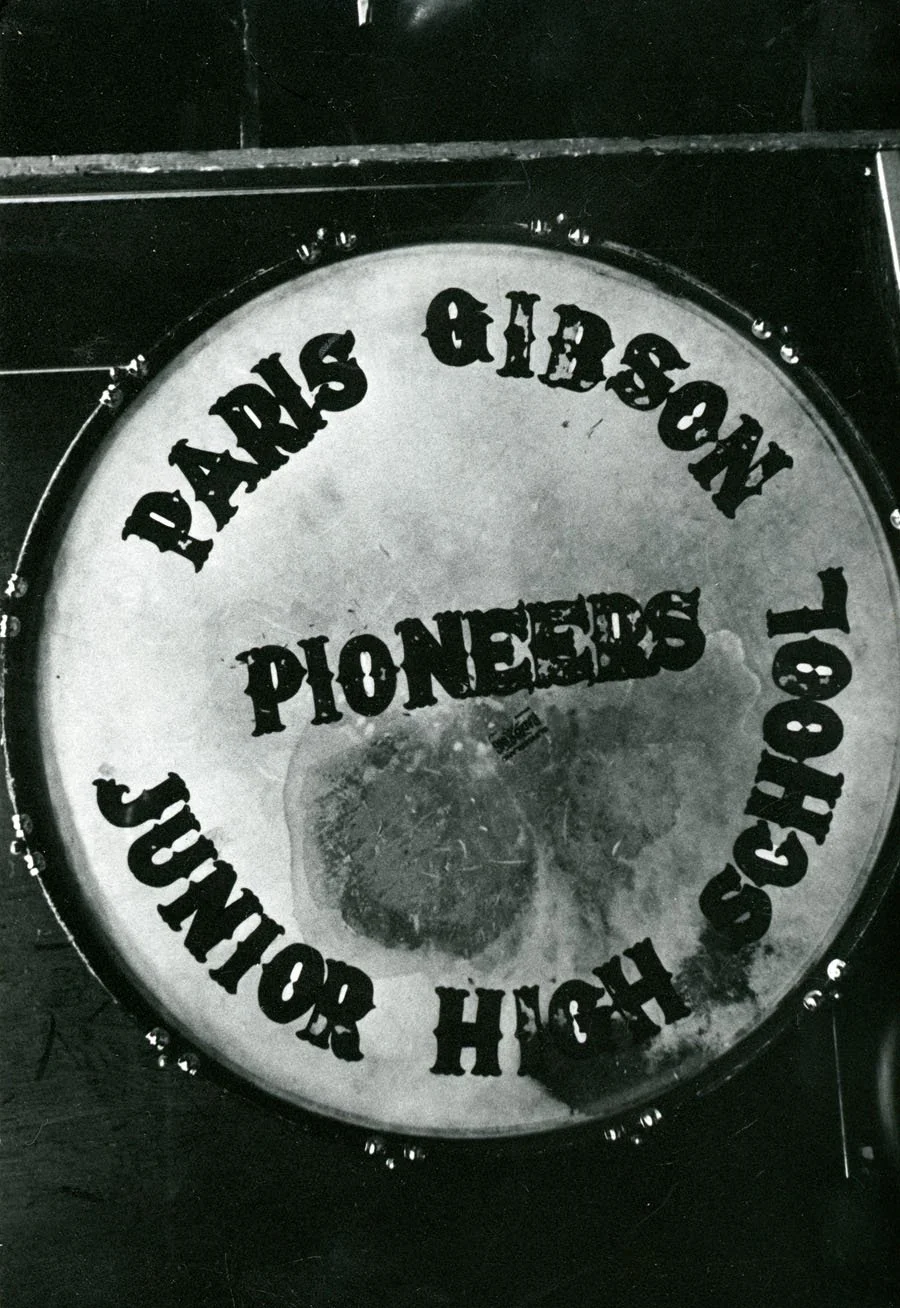
Photograph of Paris Gibson Junior High School Band Bass Drum [2007.017.0752]
1975 – On May 20, 1975, there was a community farewell to Paris Gibson Junior High School for the public. The Save Paris Gibson group met in the library of the school, (in the brick building) and had a tour of the building. The group was larger than before. We signed an attendance sheet and decided to call ourselves, the Paris Gibson Community Center Task Force.
On October 8, 1975, we met at the Devonshire Townhouse Club rooms. It was a stormy night with heavy wet snow. Kathie Rice was chairman of this meeting, John Bailey, and only two or three others in addition to myself were present. John Bailey who was the original chairman for the Paris Gibson Project, said his workload was being doubled and he would not be able to continue as president but would continue on the task force.
On November 22, 2975, the Paris Gibson Task Force met at the Civic Center, along with others interested in historic preservation, for a meeting with Carol. J. Galbreath, a Regional planner with the National Trust for Historic Preservation, and Bradford Paul, a service assistant with the Trust. They were both from the San Francisco office, and Al. Thompson from the Montana State Preservation office in Helena, which was under the auspices of the Fish and Game Department of Montana. This meeting was chaired by Margaret Pennington.
The National Trust people had been in Helena for a meeting at which some Great Falls people, including John Bailey, Margaret Pennington, and Ruth Strain had been present, and since they were scheduled to go to Billings too, the Great Falls people were able to persuade them to make an extra stop in Great Falls.
Immediately following the morning meeting, the following people met for a no-host luncheon at the Import Depot with the speakers; Robin Bailey, Diane Emmons, Elliot Dybdal, Jim Poor, Kathy Rice, Clara Heffern, Roger Young, Harold Wenass, Ken Dunham. Our first concern now was to learn how to go about getting the old stone building on the National Register of Historic buildings so that we could become eligible for National Trust grants.
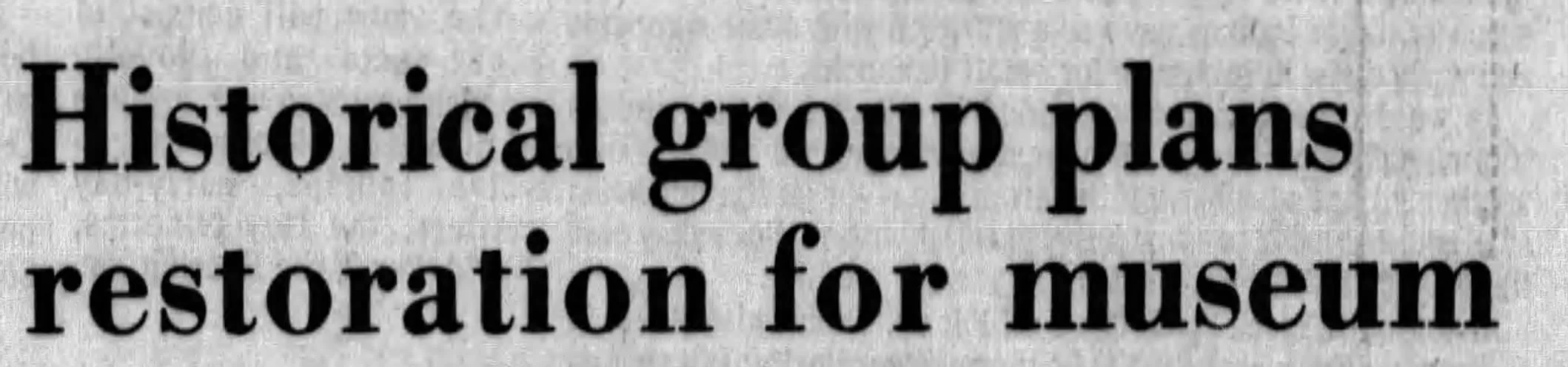
Headline from Great Falls Tribune, March 30, 1976, “Historical group plans restoration for museum”
We learned that the trust money is granted on a fifty-fifty matching basis and that a lot of work would be required before we could even make a proper presentation of our request to the National Trust, including an architect’s rendition and plans, in addition to committing ourselves to raising sums of money that seemed staggering to me.
On December 10, 1975, we had the first in a long series of meetings at the Presbyterian church. These first ones were in the basement large meeting room. This was the first meeting at which minutes were kept for The Center for the Arts, meaning the Paris Gibson Task Force.
Pauline Dahl became the president, and Kathy Rice became Secretary/Treasurer. Committees had been formed and the chairmen who had been appointed previously, now named their committee members. Jean Warden was acting secretary for this meeting. John Bailey was By-laws chairman, which Neil Ugrin and Pauline Dahl on his committee. Jim Poor was Program Chairman, with the following sub-committee chairman as his committee, Clara Heffern, Historic Museum chairman; Diane Volk, Arts Sub-chairman and George Camp, Funding Committee member.
My Historic Museum Sub-Committee had the following members, Judy Birch, Tony Dalich, Mary Lou Johnson, Joe Wolff, Ruth Strain, Connie McKay, Kathy Titus, Vivian Ellis, Olga Koen. Our purpose was to bring together individuals and groups interested in forming an historical society with the objective of establishing an historical museum as part of the Center for the Arts, to locate and acquire museum items and to set a policy regarding quality acquisitions.
The other Center for the Arts committees then were the Funding Committee with Jan Block, chairman; Publicity, Jan McManus; Grounds, Molly Person; Building, Elliot Dybdal. (The Publicity Chairman was instructed to release one news article regarding an Activity Center, now to be called the Center for the Arts and listing officers and committee chairmen and to research background material on Paris Gibson Junior High School to be used in future releases.)
On December 15, 1975, there was a no-host luncheon meeting at Gordon’s for members of the Program Committee, Poor, Camp, Volk, Heffern.
1976- In the second official minutes for the January 14, 1976, meeting of the Center for the Arts, there is a quote from the report of the Historical Program chairman, (Clara Heffern). “Clara mentioned that the present bylaws of the old Great Falls Arts Council need clarification in specific areas to include direct mention of the historical aspect of our group.” (This was in reference to John Bailey’s Bylaws committee report. “Jon Bailey reported the Great Falls Arts Council Bylaws were well written and generally very suitable for out purposes. John will contact old Arts Council Board members to secure their assistance in changing that Board Membership to accommodate the needs of our group.”)
Names for the group during our numerous discussions were first, Save Paris Gibson Task Force, Center for the Arts, Center for Arts and History, Community Activity Center, Museum and Arts Center, Creative Arts Center and Museum, Arts and History Center, Landmark Center, Heritage Square.
I continually rejected names which said Art Center without any reference to History and suggested that either both art and history should be mentioned or that neither should be mentioned and finally in July 1976, Paris Gibson Square was selected.
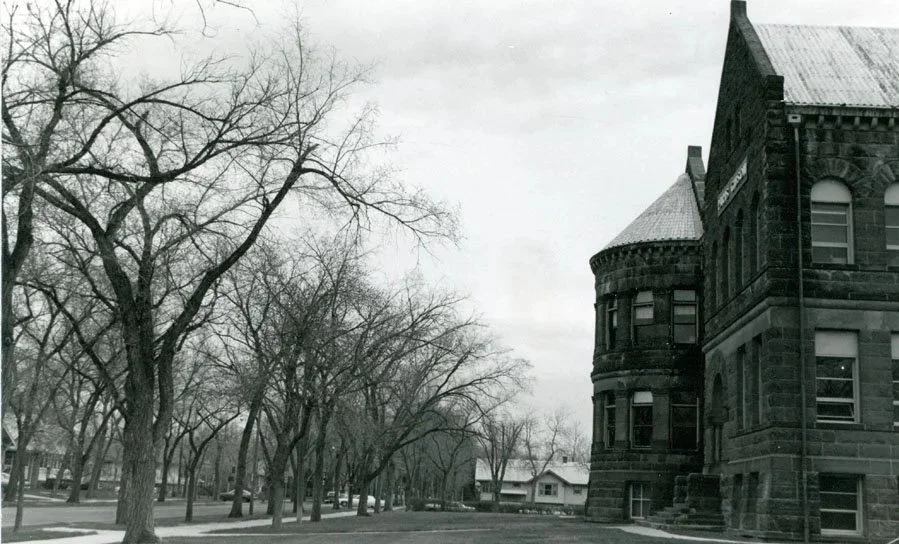
Paris Gibson Square, 1977-1978, photographed by John Staub. [2007.017.0760]
The new Paris Gibson Square board worked with architects and looked into the needs of the different groups interested in being the building to which ones could be accommodated within the physical limits of the building and also which activities would fit into the basic philosophy for the use of the building.
Now we have reached where the chairman for the Sub-committee for History was asked to define in more detail what the history aspect should be. (Note- Until now, other people from the Citizens Involvement Committee and the Community meeting who had indicated an interest in Paris Gibson Square from the history standpoint, Kathy Titus, Vivian Ellis and Ruth Strain had never received a call for the meetings, so I was still the spokesman.) I reported that the sub-committee for history had invited a group to my home to discuss a course of action. We agreed that part of the history committee’s function should be to collect and preserve objects that might otherwise be lost to posterity. This meeting, on January 8, 1976, the history group had begun making lists of individuals and organizations known to those present to be interested in preserving local history.
At this point of the task force meeting, Elliott Dybdal stated that he thought that the scope of the work in management of this new cultural center would be so large and demanding that the task force could not, and should not take the responsibility for acquiring and caring for the objects an historical museum normally would have.
By now the local arts groups which were already in existence could agree to work together on a program of arts exhibits and classes but the people who were history museum enthusiasts did not have a focal group, except for the Sons of Pioneers in which membership was limited to men who were sons of Montana or Cascade County pioneers. Other history buffs were not organized but at the meeting of the history group on January 8, I had received assurance from those present that the group should (this section was typed over and illegible) ever would be involved in establishing a history museum, so I was able to tell the Center for the Arts that we were organizing to give the history program the type of support that the arts groups offered. The Great Falls Genealogy Society had been organized in 1975 and they were also seeking a home in Paris Gibson Square but their interest was strictly limited to genealogy.
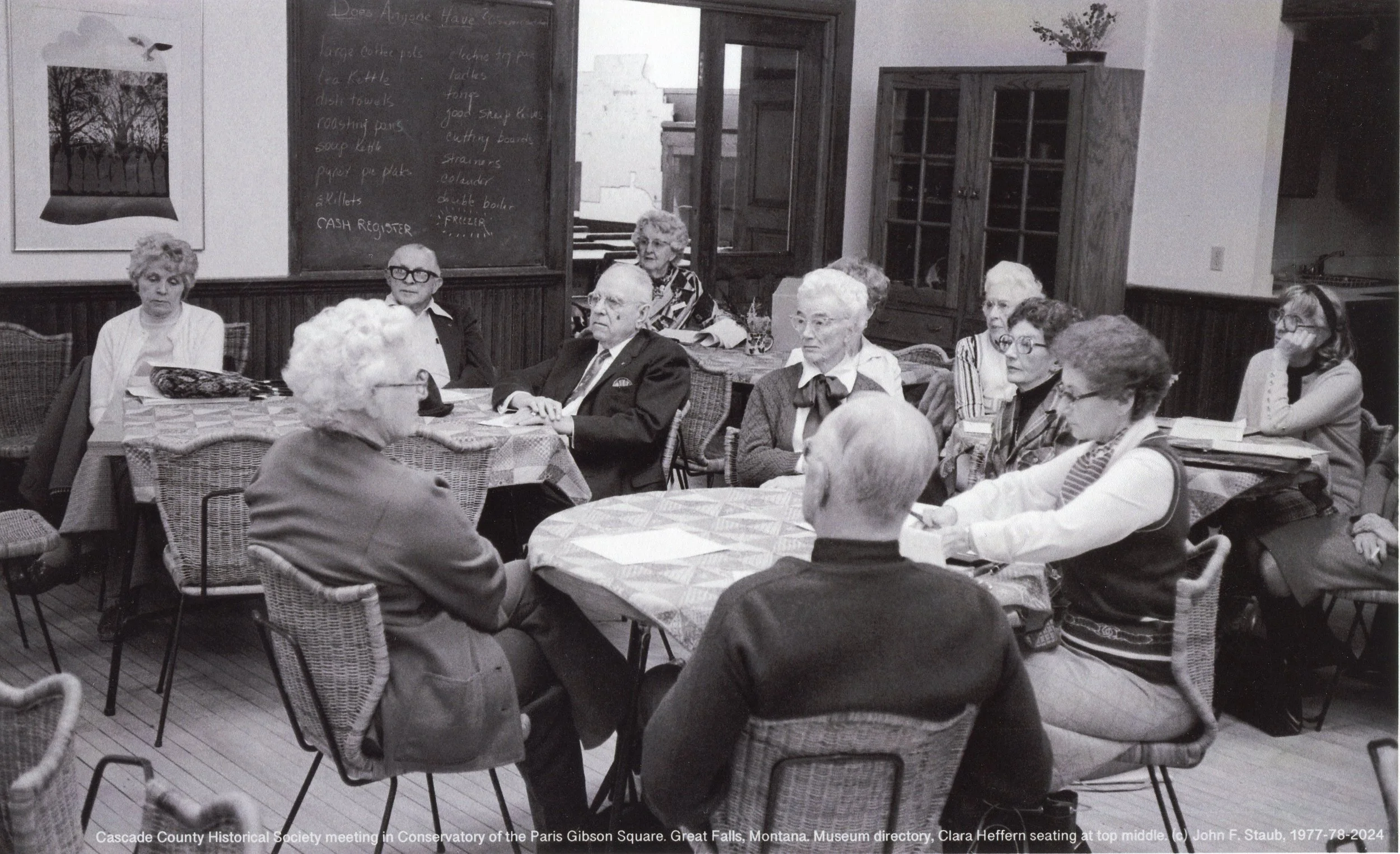
Cascade County Historical Society Meeting at Paris Gibson Square, 1978, photographed by John Staub. [2025.035]
From here on I will confine my remarks to the development of the Cascade County Historical Society.
January 8, 1976 – The first names I called for this organization meeting were those of people whose names were on the task force list as having been at the CIC or Community meetings but had never received a follow-up call to attend Task Force meetings. They were Judy Birch, Vivian Ellis, Ruth Strain and Kathy Titus. The others I called were Joe and Beth Wolff, Charles and Sue Bovey, Constance McKay, Albert Fousek, and Tony Dalich, all known to us as being interested in history and preservation, and Doris Pascal, Dorotha Rector, Henrietta Loucks, Olga Koen, and George Roberts, who had expressed interest following an AAUW meeting at which I had announced that plans were in progress. These people, in addition to Brett Asselstine, who joined us when we asked for his assistance in incorporating, and myself, formed the incorporation board.
Of these people some were not able to be at the January 8th meeting, but all endorsed the concept of organization as an historical society and a history museum and wanted to be called for any subsequent meetings.
At this first meeting, those present agreed that we should explore the question of whether we as an historical society with a museum would be duplicating anything that was being done by any other group, and we began to list organizations and individuals to contact and to explore this in depth.
Original Logo for the Cascade County Historical Society
Unfortunately, this is where Clara’s commentary ends. We suspect she had written more, but the copy we have is incomplete. It is fascinating to read about our origins from a first-hand account and about how the community worked towards saving the old High School while looking to improve the cultural landscape.