
The Stanton Bank Tod Block Fire
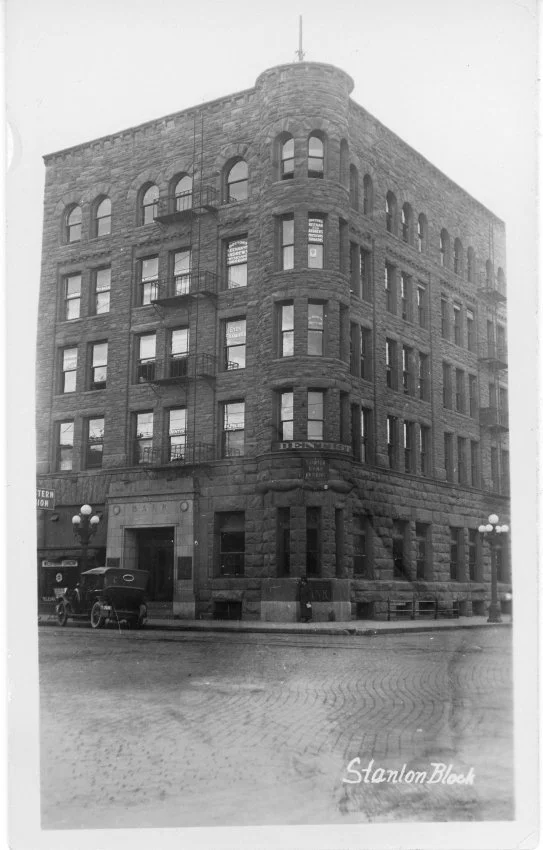
A view of the Tod Block/ Stanton Bank, c. 1925. Sargent Collection. [2025.005.0015]
Just before her 9am shift on Sunday, December 9, 1928, Mrs. Mabel Curran arrived to work at the Tod Building. The tall sandstone building, completed in 1892, stood proudly at the corner of Central Avenue and Second Street North. It was built by J. Stewart Tod, housing two other banks before it was purchased by the Stanton Trust and Savings Company in 1914. Law firms, doctors offices, and apartments filled the block which was the first five-story building constructed in the city. Mrs. Curran was the operator on duty Sunday morning for the building’s hydraulic elevator.
Not long into her shift, Mrs. Curran noticed a suspicious smell that she thought could be a gas leak. She ran the elevator to the basement, then to the first floor, not finding more convincing evidence. As soon as she began pulling out her needle work, she noticed the elevator floor was warm. Suddenly, flames shot out from the elevator shaft.
She began shouting FIRE, running the elevator to the multiple floors to alert occupants, including the janitor’s wife, Mrs. V. Paulsen on the 5th floor. Ed Klies, owner of the garage across the street, sounded the alarm for the fire department, who arrived on scene to help evacuate the building.
The 1890 building, made of stone, brick, and wood, burned like tinder.
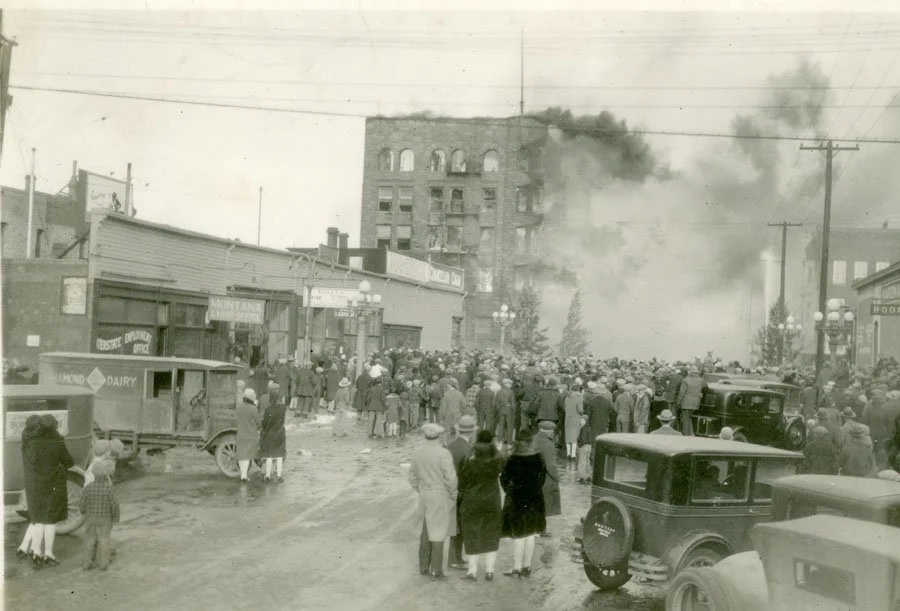
A crowd of spectators watch the enormous fire, view from Second Street South looking North. Christmas trees line Central Avenue. December 9, 1928. Great Falls Photo View Co. photograph, Junior League Collection. [2007.017.0808]
Building residents and occupants had to quickly evacuate. J. F. Clifford, whose losses were were over over $10,000 said:
“I was working in my office about 9:30 when the janitress [wife of the janitor, Mrs. V. Paulsen] of the building came rushing in, carrying her 10-year-old daughter wrapped in the blanket. She said the elevator shaft was on fire. Her little girl had been sick and she said her husband was in the basement and she was afraid he had been killed. He came up a minute later, all smoked up and exhausted from his experience in coming through the fire and smoke.”
Mr. V. Paulsen was the building’s janitor and a fireman himself. He had been taking a bath when the alarm sounded, and quickly slipped into a pair of overalls before running out into the hall and escaping the building.
Dr. Margaret Westmiller, a chiropractor on the fifth floor, escaped through the fire escape with her patient Mrs. George Williams of Brady, Montana but not before her hair was singed by the flames erupting through the main stairway. Both women were slightly burned, but otherwise uninjured.
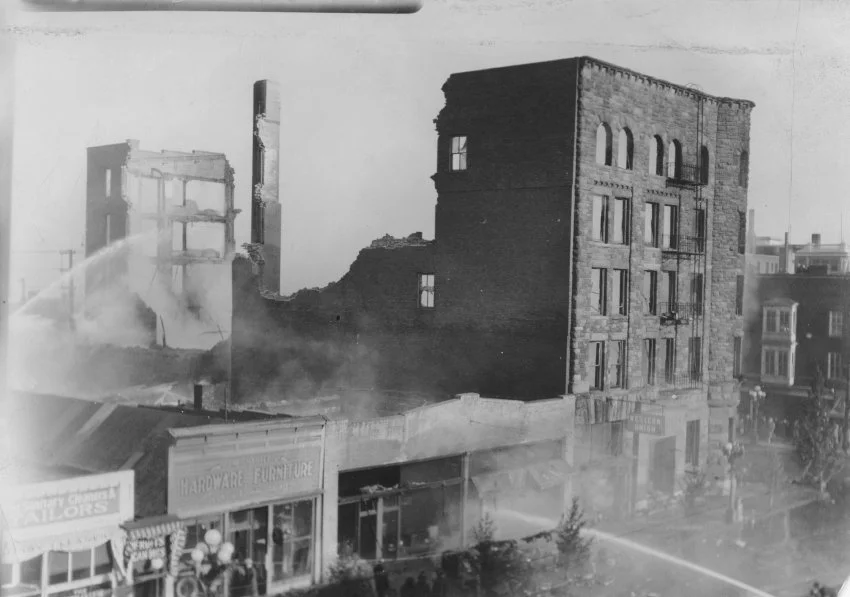
Streams of water continue to douse neighboring buildings after only the ruins of the Tod Block remain. In the foreground, a blast of water enters the neighboring Manchester Pet Store. The fish were the only survivors. Great Falls Photo View Co. photograph. [1987.093.0049]
Firemen poured streams of water from every direction, but making headway against the inferno was impossible. They turned their attention to stopping the spread of the fire to adjoining buildings. Minutes later, the north wall of the building fell and crashed across the alleyway, smashing the second story of the Jewell apartments. A few spectators on the roof narrowly escaped. The fire spread to the surrounding single story structures, and part of the west wall collapsed through the roof a new neighboring addition on the Charteris hardware store building.
The fire became a spectator event, and police had to rope off a line to keep the public away from the stone walls which began to sway and crumble. Adjoining buildings were crushed and ignited by falling walls, flying embers started other fires, and apartments were evacuated, putting 40 people on the street to watch their homes burn.
Firemen from the Anaconda Copper Mining Company were also quick to arrive on scene, brining 3,000 feet of hose and promptly addressing spreading fires in the neighboring residential sections to the northside. The roof of the Clevenger home at 200 3rd Street North even caught fire but was quickly extinguished.
Firemen narrowly avoided falling debris, Lieutenant A.P. Shanahan was cut by glass.
Watermains burst during and after the Stanton bank fire due to the extra pressure on the city water system. Heat from the fire cracked the glass across the street from the bank. The Murphy-Maclay, Sherlock real estate offices, the Hart and Emerson offices, and Klies Motor company windows were broken. A large power line pole crashed from the alley into Second Street.
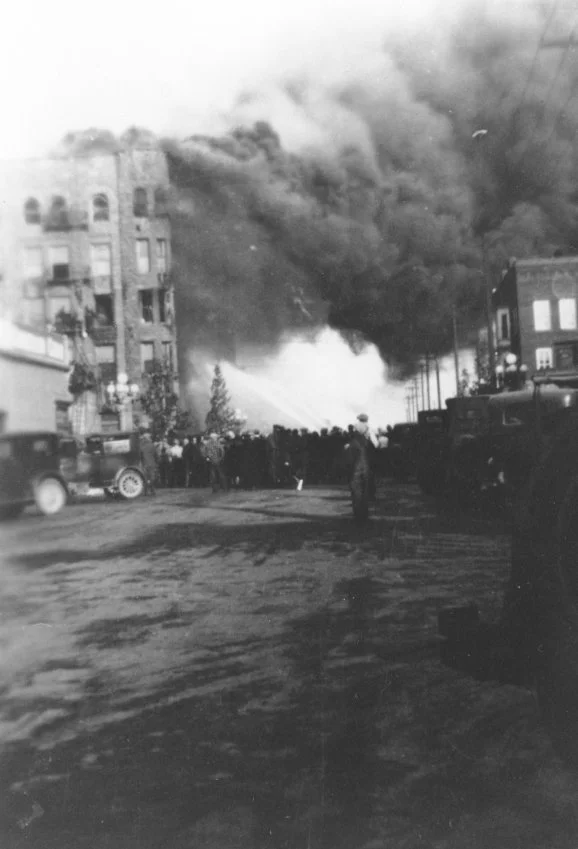
In this view from Second Street South, action from firehoses can be seen combatting the flames. [1987.040.0003]
One woman was rescued by Trodick from the 3rd floor. She was preparing to jump – Trodick waved for her to remain in the building and brought her down on a ladder.
“The Stanton bank fire was the most serious from the standpoint of menace to the city, as well as to probably total loss, as any in my 20 odd years of fire fighting here” - Fire Chief A. J. Trodick
The loss included tens of thousands of dollars in attorneys’, doctors’, and engineer’s records. “Some of these papers, along with art objects, cannot be replaced.” Several art pieces included wax work and paintings by Charlie Russell. Works by John Clarke, Charles Beil, and Native American works were lost.
The Underwood Typewriter Company and the Western Union Telegraph Company were heavy losses, and the Great Falls Municipal band and Musicians’ union lost their entire musical library and many valuable instruments.
Dr. T. F. Walker, whose laboratories and equipment were entirely destroyed, had an approximate loss of $30,000.
The Tod Block/Stanton Bank Block was built in 1890 at a cost of $110,000, was insured for $152,000.
Pacific Coast Adjustment Company Manager, C. C. Oakes, made early statements to the Great Falls Leader Monday, December 10:
“The building was of that old type of construction that makes a fire difficult to cope with when a blaze starts. The wood was old and dried and burned with amazing rapidity. The elevator shaft was of old construction with the stairway winding around it.
“Modern elevators have automatic appliances that shut off the shaft so fire cannot mount from one story to the other. But in the Stanton block there was nothing of that kind. The fire, starting in the basement, swept up to the top with a speed that even made it difficult for people in the building to escape and the firemen were helpless to save the building or its contents.”
Oakes gave the fire department full credit for preventing the spread of the blaze.
In the aftermath of the fire, a crew of 30 men with four large trucks worked to remove 5 safes buried beneath brick and timber and remove the mass of debris filling the basement. The sidewalks surrounding the building were damaged, leaving large holes on Central and a completely demolished sidewalk on the Second Street side. They would be repaired after demolition of the remaining walls.
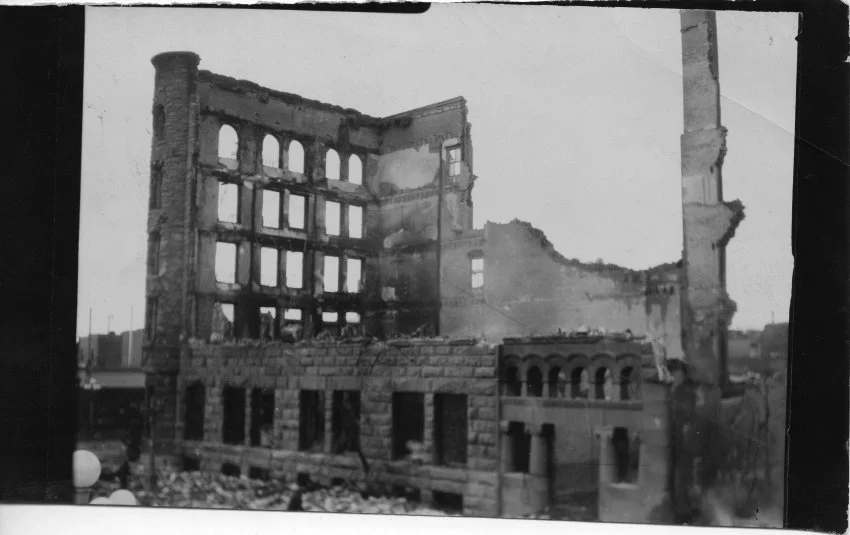
The crumbling remains of the Tod Block the following morning, Great Falls Photo View Co. photograph. [1987.093.0048]
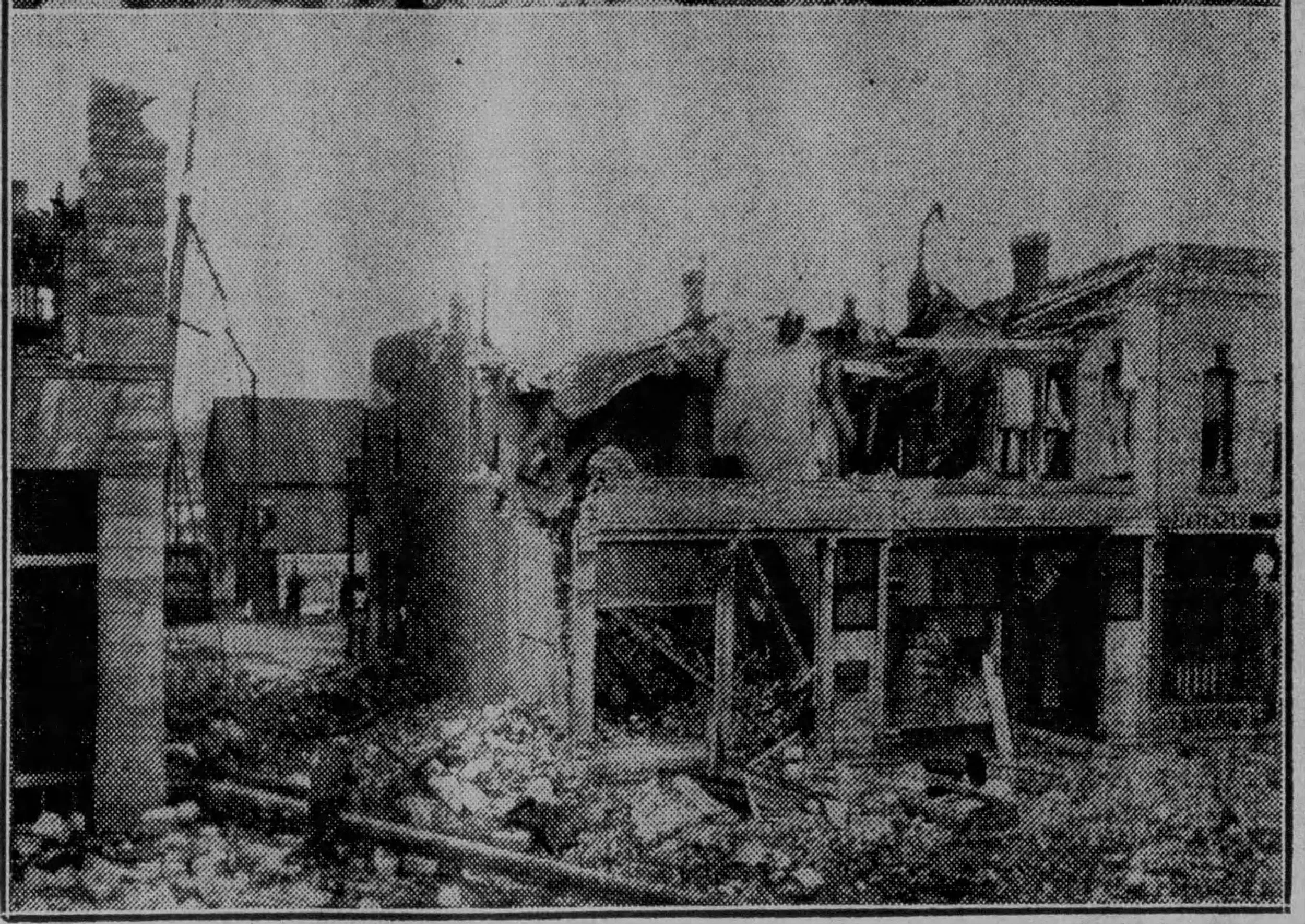
Next morning’s aftermath of the Jewell Apartments when the north wall of the towering building collapsed. Great Falls Leader clipping, Great Falls Photo View Co. photograph, Monday, December 10, 1928.
The State Fire Marshall, William G. Brooks of Helena, concluded that the fire was caused by a gas leak, and faulty elevator equipment sparked the fire. Great Falls Gas Company disputed this, but the Marshall held his statement.
Mrs. Mabel Curran was quoted by the Tribune: “No doubt I was fortunate to escape uninjured, but I did not like to lose my coat and hat. I also have lost my job, but perhaps I can find another.” She would later work as an elevator operator in the Medical Arts Building at 1st Avenue North until her retirement.
Published in the Leader on the 10th, “The Lesson of the Big Fire,” more facilities, man power, and modern equipment is required. The bank was an example of outdated building: wood construction throughout its interior, wood flooring instead of concrete, no pipes running up through the building to attach fire hoses.
Aerial or combination towers were called for.
“The chief of the fire department has been arguing, pleading, for this and other modern equipment for years. He has been asking also for more pumpers (the city now has two) and more man power. It is difficult for anyone who watched the progress of yesterday’s blaze to disagree with him.”
“Great Falls is like the boy who suddenly shoots upward and adds to his stature faster than his parent provide him with new clothes; his trousers fail to touch his shoe tops, his coat merely reaches to the middle of his back. Great Falls has outgrown its fire department and in this era of rapid building construction here it is getting farther away from it every day. We need a department better equipped to cope with the fire fiend.” Great Falls Leader, December 10, 1928.
In 1930, Great Falls voters approved a proposal for $105,000 for fire improvements among over 1 million in bonds (over $1.9 million for a population of 41,146).
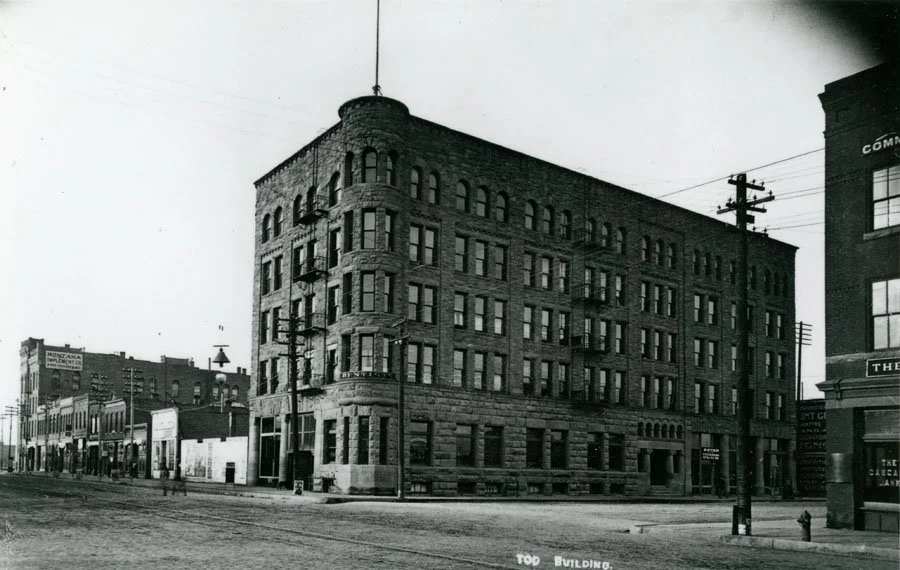
Tod Building, late 1800s to early 1900s. [2007.017.0236]
-Ashleigh McCann, Collections Curator