
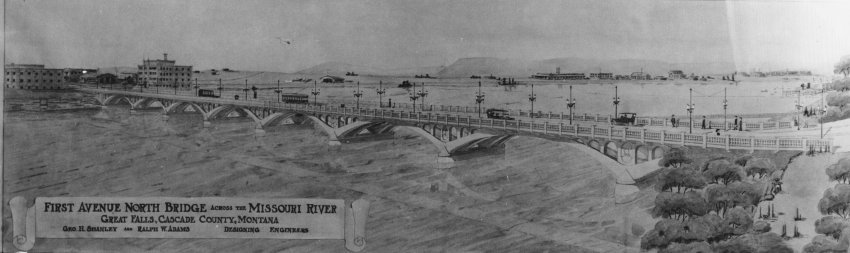
Architectural drawing of the First Avenue North Bridge over the Missouri River by George H. Shanley and Ralph W. Adams, circa 1916. [1990.026.0580]
Two matching bridges were planned for Great Falls to create an elegant entrance into the west and north ends of the city.
The Great Falls Tribune published news on May 13, 1919 that five plans for bridge design were submitted to the Montana State Highway Commission, and their choice would be made May 19. The proposals included two open spandrel designs, a barrel arch with dirt fill, a rib arch bridge, and a girder type bridge. The open spandrel design by Adams of Spokane, WA and George H. Shanley of Great Falls was ultimately chosen.
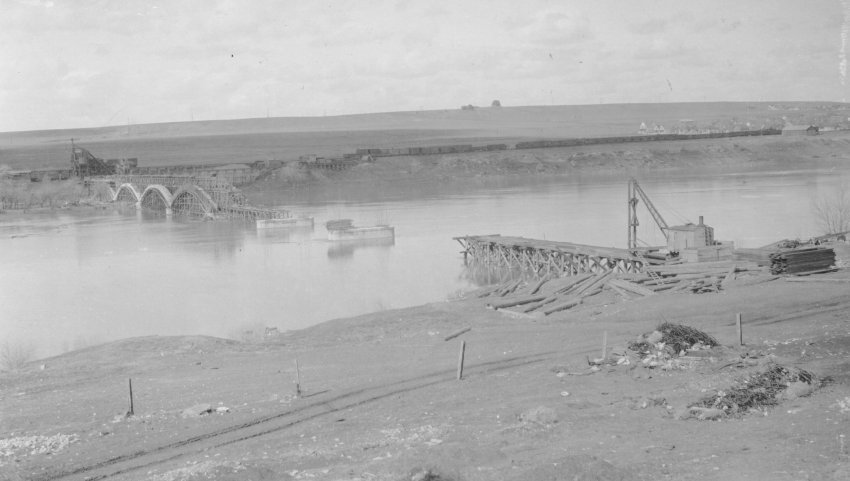
Photograph of the 10th Street Bridge under construction, circa 1920. Unknown photographer. [1995.005.0001]
The 1st Avenue North/Central Avenue West bridge was completed in 1919, and the 10th Street Bridge was completed in 1920. The 1919 bridge spanned a shorter distance than her younger sister, and the 10th Street Bridge became, and still holds the title of, the longest open-spandrel arch bridge in Montana at 1,130 feet in length.
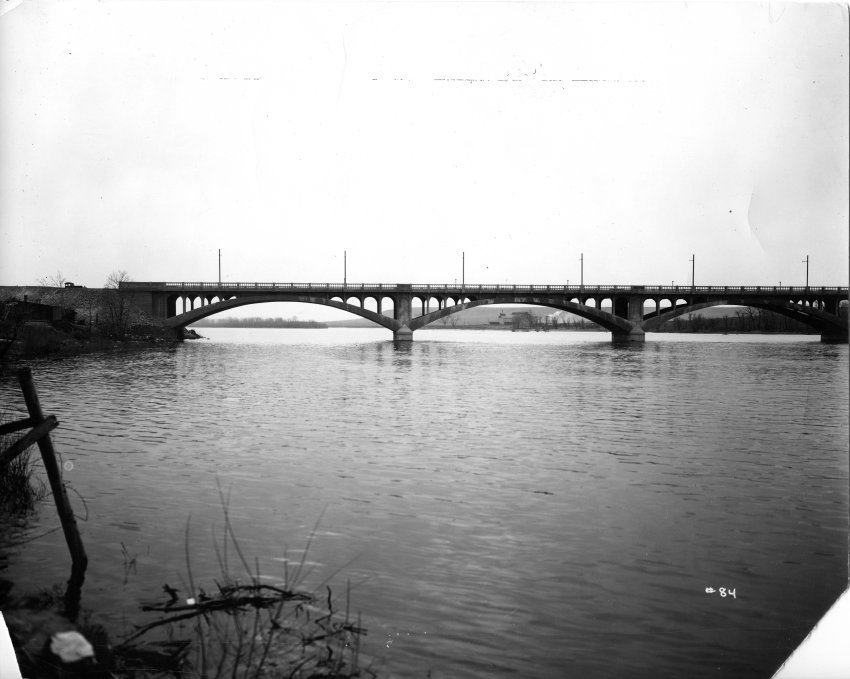
Photograph of the 10th Street Bridge, circa 1920. Unknown photographer. [1990.026.0001]
In 1980, a new bridge connecting 1st Avenue North and Central Avenue West was announced. The 1919 spandrel arch bridge was quickly demolished, and the new bridge was completed in 1981.
A similar fate was destined for the 10th Street Bridge. In 1991, state transportation engineers gave top priority to the construction of a new 9th Street Bridge that would connect 9th Avenue North to 10 Street North across the river, though the process would be delayed for a few years.
“Goodbye to olden arches” was the headline of the Great Falls Tribune Friday, October 7, 1994. The deteriorating, multi-arched bridge would be demolished after the new bridge was completed and in use, work to begin the following year.
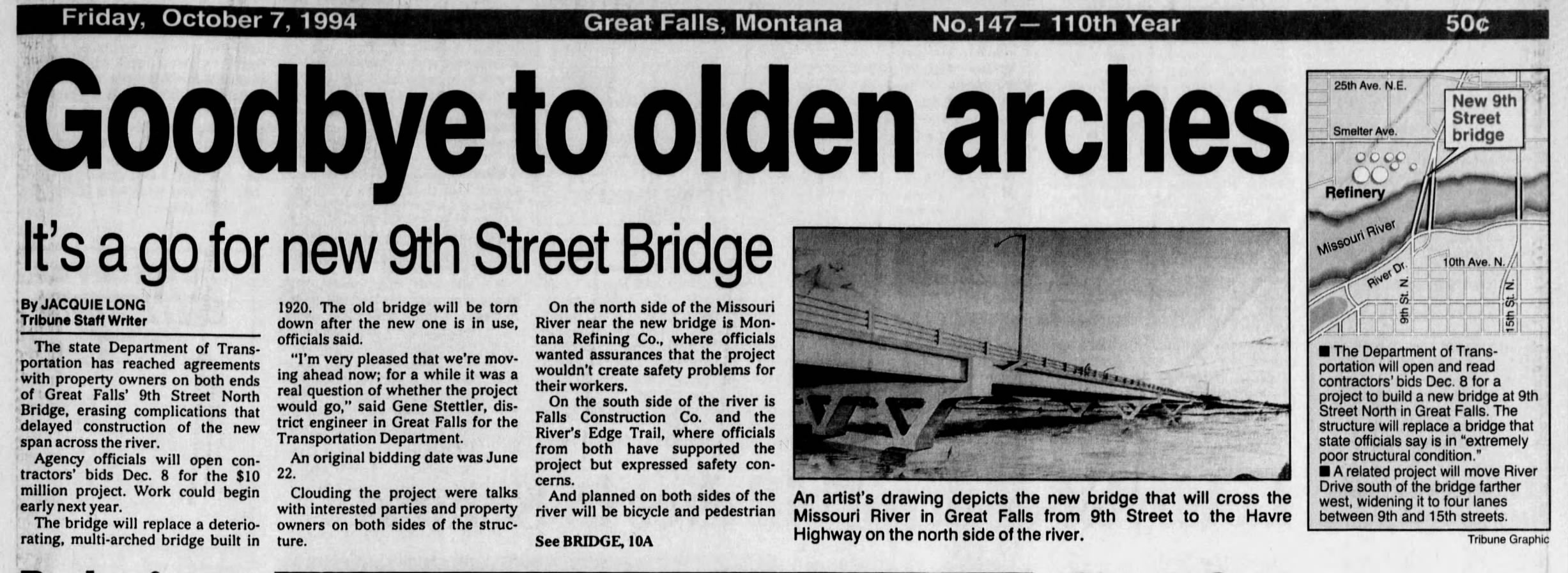
“Goodby to olden arches” Great Falls Tribune clipping, October 7, 1994 with illustration of the new 9th Street Bridge and its location.
Arlyne Reichert leapt into action. On October 17, 1994, Reichert’s letter to the editor, “Save the olden arches” was published. In it, she wrote that preserving the 10th Street Bridge was a logical way to connect the newly developed River’s Edge Trail, and that the destruction of the bridge would be another historic loss for the city.
“Why destroy a structure that is so aesthetically pleasing and which could benefit the community as a recreational focal point? It would be sad to these the old bridge go the way of the Opera House and the smelter stack. Why not preserve it, as we have done for Paris Gibson Square?”
Reichert called for readers to attend a public hearing at MSU College of Technology.
“If we do not make every effort to save our bridge now, it will be too late.”
In November 1994, the Save the Bridge Committee was formed under the Cascade County Historical Society.
“The Historical Society hopes that in the effort to answer new and faster transportation needs, the past that forms such an important part of our identity is not destroyed. Once gone, such elements can never be retrieved, and we are left only with the myriad of statements, beginning with the phrase ‘we never should have…’” Cindy Kittredge, letter of support, June 22, 1995
Federal law allowed funds reserved for demolition of the historic bridge to be put instead towards preserving it. The demolition cost was an estimated $700,000.
The bridge project attracted critics as well as supporters. Common criticisms were that the new bridge should be designed to look like the old one, that the smell of the refinery would prohibit pedestrian use of the bridge, and generally that money should not be wasted on an aging structure. Bridge supporters argued that making a new bridge look like the Shanely design would be prohibitively costly, and that records from the U.S. Weather Service indicated that the prevailing winds for the past 30 years were from the southwest – away from the bridge.
“It is difficult to understand why a community would prefer an enormous pile of rubble and environmental degradation when the same dollars could be recycled on a functional component of the transportation system, serving pedestrians and adding to the beauty of the area.” -Arlyne Reichert, Preserving our Heritage for the Future, Aurora Magazine article
The bridge’s surfaces were in a crumbling state, but preservationists rightfully argued that the underlying structure was sound. Funds would be needed to repair the surface decking, balusters, and rails.
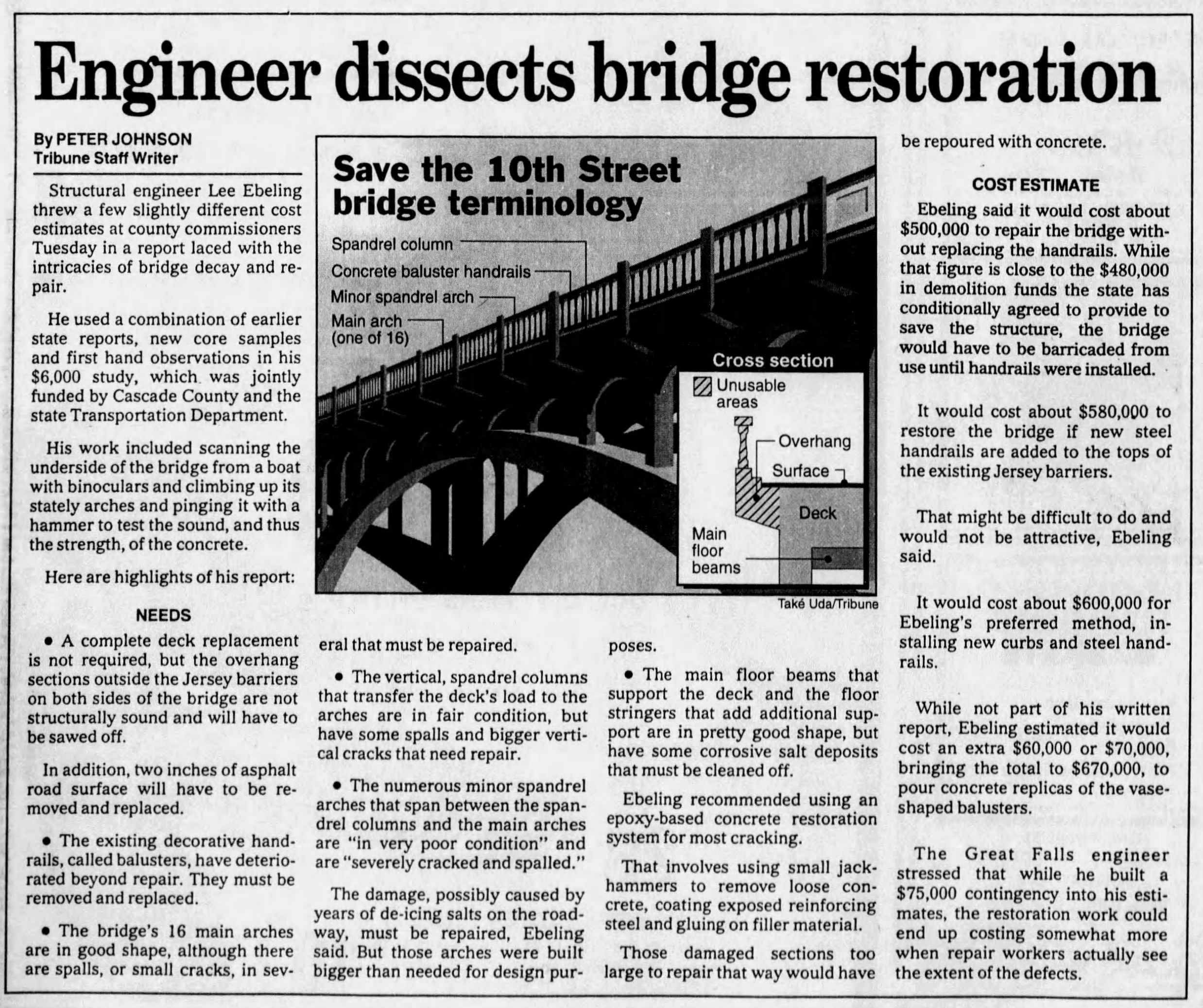
Clipping of the Great Falls Tribune, May 24, 1995 “Engineer dissects bridge restoration” by Peter Johnson with graphic by Také Uda.
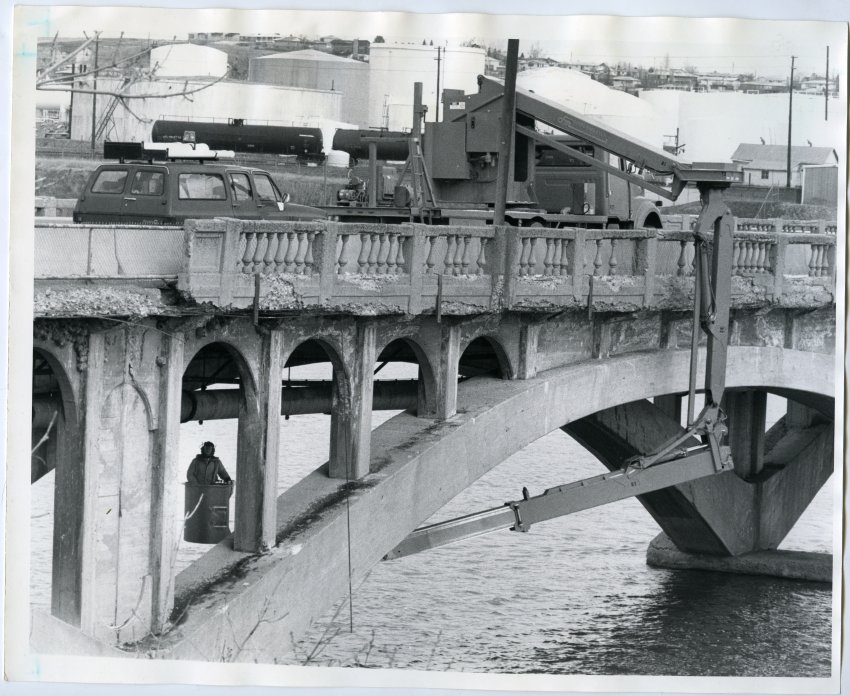
This 1990 photograph of the 10th Street Bridge shows the condition of the concrete balusters. [Great Falls Tribune Collection, 2022.005A.0305]
“Fellow citizens, the 10th Street Bridge may be old and need some repairs but it is structurally very sound. They don’t make them like that anymore. […] Pedestrian bridges are a hit all over this country. I challenge you to do your homework before you write the 10th Street Bridge off. Television has been promoting “Positive Great Falls” ads. What is positive about blowing up the 10th Street Bridge? […]” Jodi Ruffini, Our Reader’s Views, Great Falls Tribune, September 10, 1996.
On the Bridge’s 75th diamond birthday celebration, the Cascade County Historical Society sponsored “Hands Across the Bridge,” an event kicking off National Preservation Week in May 1995. The bridge opened for only pedestrian traffic at 2pm. Residents linked hands across the bridge, and enjoyed period 1920s music. Cascade County Historical Society produced an exhibition, “A Bridge Across Time,” that featured historic and contemporary images of the bridge. More than 500 people attended.
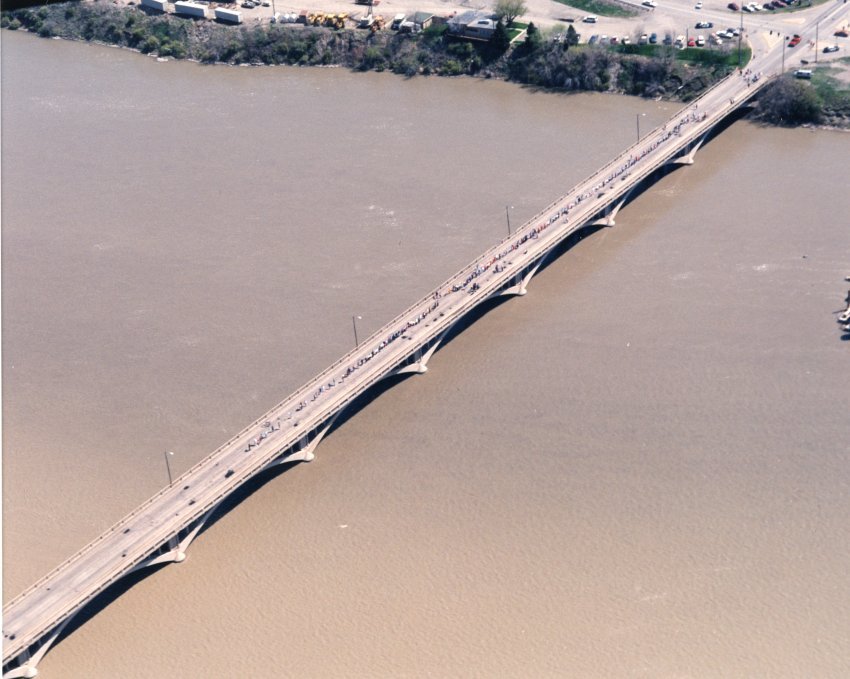
Aerial photograph of the “Hands Across the Bridge” campaign, May 14, 1995. Unknown photographer. [1995.056.0001]
In May 1996, the bridge was successfully added to the National Register of Historic Places. That same year, the Save the Bridge Committee filed as a separate 501(c)(3) and became Preservation Cascade.
In August 1996, the 9th U.S. Circuit Court of Appeals temporarily blocked demolition of the 10th Street Bridge. After a long legal battle, the Department of Transportation transferred ownership and $400,000 earmarked for demolition to the Great Falls City Commission.
In 1998, the city approved a plan for the bridge – the bridge would involve no local tax money and allow bridge backers to raise money for maintenance. The city would maintain ownership and responsibility for contracting and insurance and other responsibilities related to the bridge’s rehabilitation in a partnership between Preservation Cascade and the National Trust for Historic Preservation.
The 10th Street Bridge project continued to face criticism as the years went on, though in a January 8, 2006 article in the Great Falls Tribune, Helen Seivert, historic preservation officer for Great Falls and Cascade County, explained that negative letters to the editor usually prompted bridge supporters to make more donations, “for every negative, there’s a positive […] Eventually, it’ll be completed.”
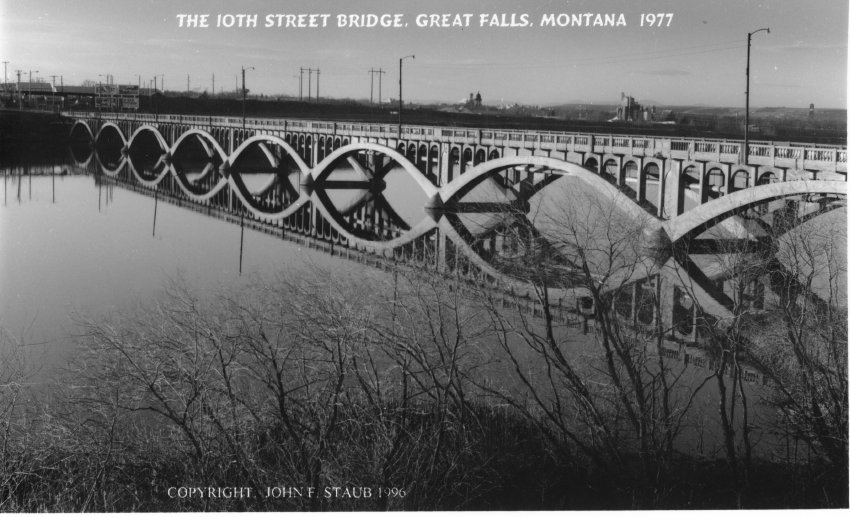
Photo postcard of the 10th Street Bridge looking southwest at dawn, 1997, by John Staub [1996.075.0074]
Federal Judge Harry Pregerson wrote a poem in 1998 advocating for the bridge:
Don’t tear her battered balustrades down! Long have they stood on high,
And many an eye has danced to see her arches against the sky;
Beneath the Missouri’s waters flow with the spirit of the Lewis and Clark;
Will the ornament of the Great Falls shore be reflected in the waters no more?
Pregerson sent the poem, a spoof of Oliver Wendell Holmes’ “Old Ironsides” and a copy of a photograph of the bridge his wife had discovered at a swap meet in Lincoln to Montana Department of Transportation officials.
“They knew their case was doomed when they got that poem and picture of the bridge,” Arlyne Reichert in a December 1, 2017 article of the news of Pregerson’s death at age 94.
Blue lights were installed on the bridge in November 2007. The blue lights were planned to be lit on holidays and weekends, with Preservation Cascade funding the electric bill. Light installation was paid for by Federal Community Transportation Enhancement Program ($120,779) and Preservation Cascade ($18,721). Miami lighting expert, Bob Daniels, was brought in to complete the design – the curve of the bridge’s arches required special care to aim the beams properly. To get the positioning right, Daniels sat in a truck at a distance while local contractors from Liberty Electric floated in a boat beside each pier on the Missouri River to make adjustments. Later Preservation Cascade offered the bridge lights to be lit for memorials and special occasions by donation.
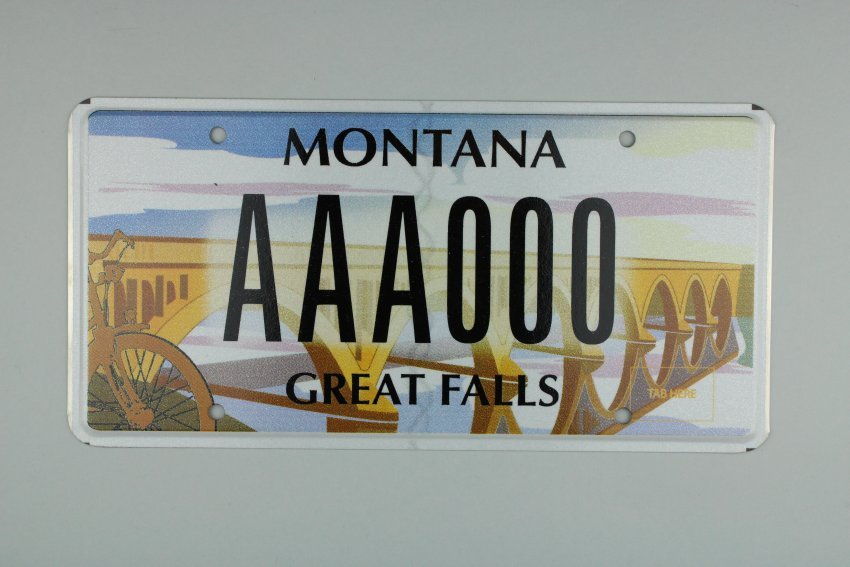
This is a sample liscense plate to raise funds for Preservation Cascade and the 10th Street Bridge. Vehicles could register for this plate with an additional fee that would support the bridge. The plate was announced in 2010, and it was deisgned by Elden Creative of Whitefish, owned by Cari and Scott Elden. Cari is a niece to Arlyne Reichert. Other community fundraising efforts included sponsoring a yard of concrete railing. [Preservation Cascade Collection, 2011.119.1]
COVID-19 mandates and precautions crushed the 100 year celebration of the 10th Street Bridge, set for August 20, 2020.
In September 2021, the 10th Street Bridge was formally named for the “Bridge Lady”: the Arlyne Reichert Community Heritage Bridge, or ARCH.
The formal ribbon-cuting ceremony to officially open the 10th Street Bridge to pedestrian traffic was finally held September 27, 2022.
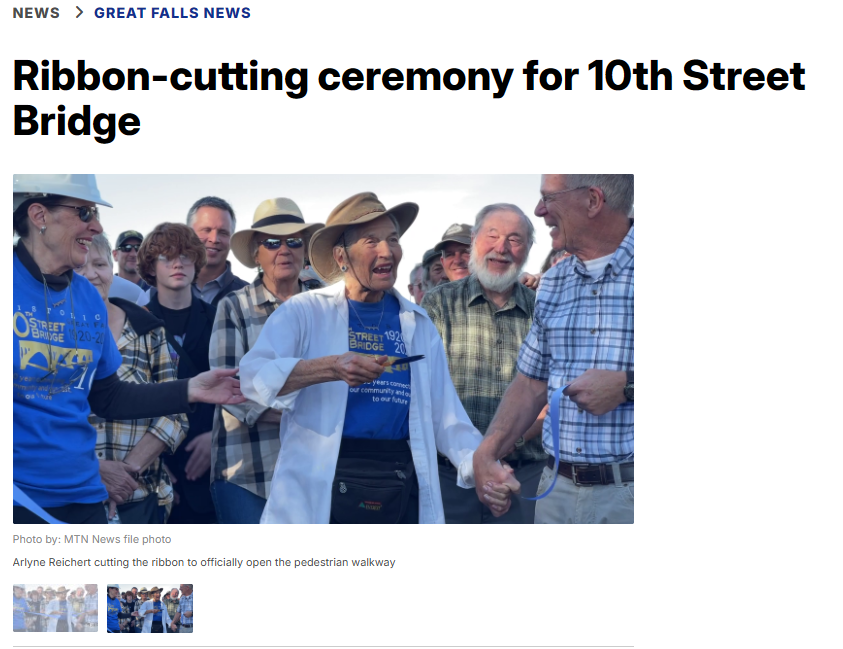
Website screenshot from KRTV, “Ribbon-cutting ceremony for 10th Street Bridge” with photograph of Arlyne Reichert with a pair of scissors. Reichert died January 14, 2026 at age 94, successfully raising millions of dollars to preserve the bridge, among many other accomplishments.
The 10th Street Bridge affected bridge preservation in Montana. In Montana’s Historic Highway Bridges: 1860-1956 by John Axline (published 2005), he notes that the agreement between the Montana Department of Transportation (MDT) and the Federal Highway Administration’s (FHWA) 1989 agreement was the first of its kind in the United States. It included a provision for the development of a historic preservation plan that resulted in preservation and rehabilitation of old bridges.
“The MDT wrote the preservation plan in 1997. That document established interpretive and educational programs, expanded the historic bridge inventory to include bridges not previously inventoried, implemented an Adopt-A-Bridge program that encouraged the relocation or adoption of historic bridges rather than their demolition, and proposed a bridge rehabilitation program. Unfortunately, not all stipulations in the plan have been successful, but it was a start and the management of historic bridge resources has increasingly become an integral part of the MDT’s programs.
“But this was not always the case. For instance, the public outcry over the impending demolition of the Tenth Street Bridge in Great Falls and the Missouri River Bridge near Wolf Point caused the department to change some of its procedures and become more active in seeking new owners for old bridges. After some debate about the usage of the structures and who would be liable for them, the bridges were turned over to the City of Great Falls and the Montana Historical Society respectively.”
Today the 10th Street Bridge has solidified itself as a local icon, used as a symbol increasingly in the community like the “Big Stack” of the Boston Montana/Anaconda Copper Mining Co. smelter.
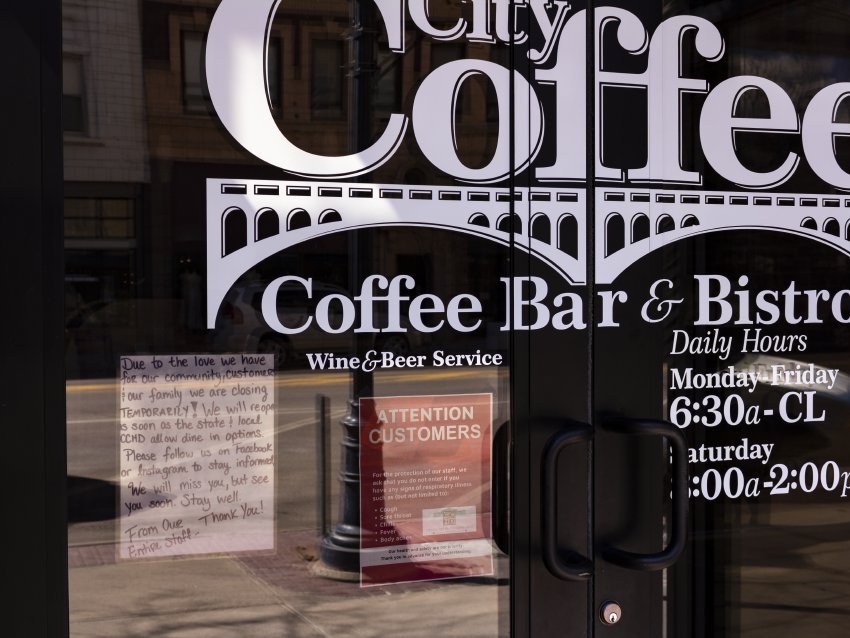
Electric City Coffee uses the 10th Street Bridge in their logo, and lit the blue bridge lights the evening of January 23, 2015 for their grand opening.
Photo: detail of Electric City Coffee’s business doors partly showing their logo and temporary notices during the COVID-19 business shutdown, April 21, 2020. Photographed by Ashleigh McCann.
“Old bridges are important visual, utilitarian, and historic components of Montana’s landscape. They are representative of the times in which they were constructed, are indicative of how transportation needs changed over time, and significant to the people who use and see them daily. Some historic bridges can not be preserved or reused due to structural conditions that make reuse financially unfeasible or because the old bridge’s location makes its retention impossible. Often, there is no public interest in saving a particular structure. Where it is possible to preserve, rehabilitate, or relocate them, however, historic bridges provide an excellent and representative view into local history and a look at what people of the past and present deem important to the prosperity of their communities and the preservation of them for future generations.” Jon Axline, Montana’s Historic Highway Bridges: 1860-1956
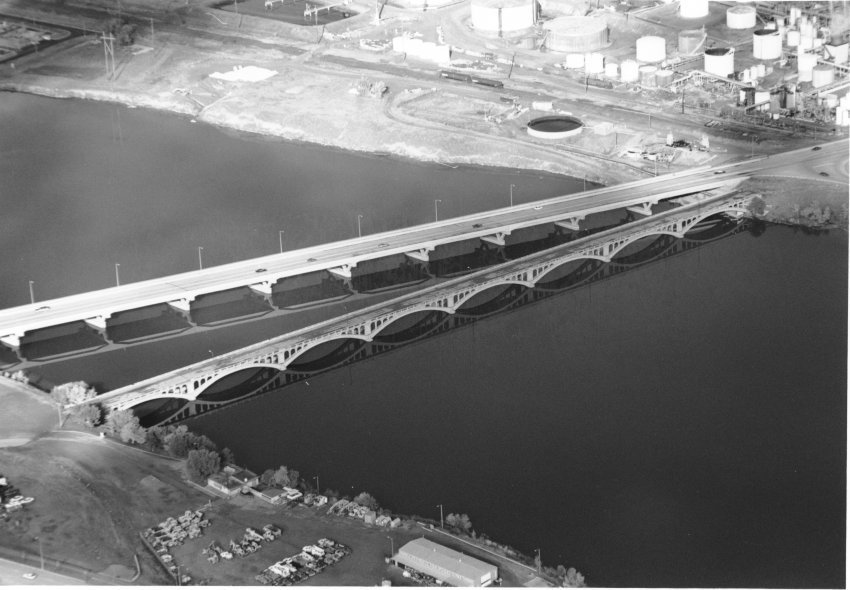
Aerial photograph of the 10th Street Bridge and 9th Street Bridge across the Missouri River in Great Falls, Montana, 1998, by Fr. Dale Peterka. [1998.086.0003]
-Ashleigh McCann, Collections Curator