
The Bovey Collection
10 Items from the Couch/Ford/Campbell/Bovey Collection: A Long Name for a Large Collection
The Bovey Collection encompasses multiple donations of photographs, records and personal papers, clothing, and other personal items connected to the Couch, Ford, Campbell, and Bovey family. Often simplfied to the Bovey Collection, it contains over 1400 individual items collected since 1986.
The earliest family member in the collection is Captain Thomas Couch, (1844-1902) born in England. The title of Captain was given to him by fellow Cornish miners at the first mine which he became superintendent. He developed large quartz veins in the American West and was recognized as one of the most important figures in the development of the copper properties in Butte. Sale of the Mountain View Mine in Butte resulted in the creation of the Boston and Montana Consolidated Copper and Silver Mining Company, with Captain Couch as its general manager. The sale of that mine to the Anaconda Copper Mining Company resulted in the construction of the smelter in Great Falls.
He married Rachel Webber, (1855-1940) a native of Wales and daughter of a pioneer miner in Utah and Nevada. They had 7 children, Thomas Jr., Edward G., Frederick M., Rachel Mary, Albert C., John D., and William.
In 1889, he purchased Robert Vaughn’s ranches at Sun River and the Misouri River, stocking them with thoroughbred cattle. After his death in California, his wife moved to California to manage his estate. Their older sons and daughter, Rachel, remained in Montana to develop the land and livestock interests. Thomas Couch Jr. organized the family into a corporation and placed the capital of the estate into land and real estate, with holdings increased to 25,000 acres in Cascade and Teton counties.
Thomas Couch Jr. (1878-1947) was one of the organizers and president of the Great Falls Automatic Telephone Company, also active in the Montana Life Insurance Company and the Northern Flax Fiber Company.
Rachel Mary Couch (1886-1957) married Lee Ford, (1883-1965) a banker and son of Robert S. Ford who founded Great Falls National Bank. Lee and his brother Shirley headed the bank after their father’s death during a golden age for development in Great Falls.
Together, Rachel and Lee had one daughter, Sue Ford, (1907-1988) who married Charles Bovey (1907-1978) in 1933, son from a wheat milling company that would become General Mills. Rachel and Lee divorced in 1930, and Rachel married Alex Campbell in 1935. Alex Campbell was a Scottish immigrant and former resident of Great Falls who created a prominent vocal studio in New York City.
Sue and Charles Bovey became well known for their interests in historic preservation and Montana history, more can be read about them here.
The collections spans several donations, the largest directly from Sue Ford Bovey’s estate, and others that were gifts from donors who purchased from the estate sale in the late 1980s. With this context in mind, Archives Manager Megan Sanford and Collections Curator Ashleigh McCann have selected 10 items from this large collection to feature.
1) Lee Ford’s Clydesdales from SC 114
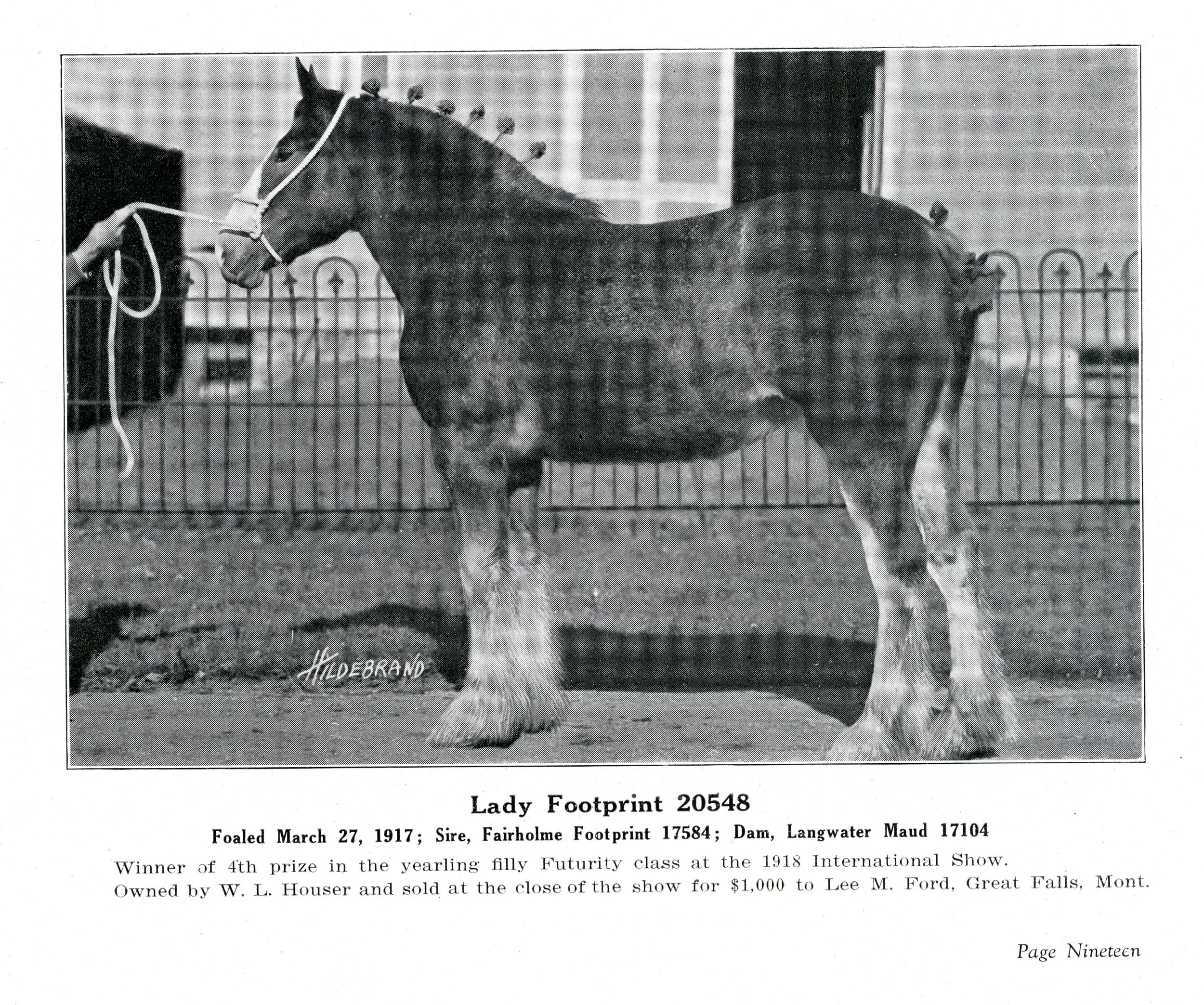
A horse of Lee Ford’s in “Clydesdale Album”
In 1918, Lee Ford took an interest in Clydesdale horses. He went to the Graham Brothers Farm in Ontario and purchased a stallion and seven Clydesdale mares. All but one of the mares was imported from England and Scotland. Mendel Prince, the 3-year old stallion became the stud sire, and was claimed to be the best Clydesdale stallion on the continent at the time. The mares were Mendel Queen, Waverly Belle, Lany Ramsey, Leather Lily, Flora of Claremont, Parkfergus Meg, Lady Maid. Lee continued to dabble in Clydesdales into the 1920s, taking them to international exhibitions and becoming a member of the executive committee of the American Clydesdale Association.
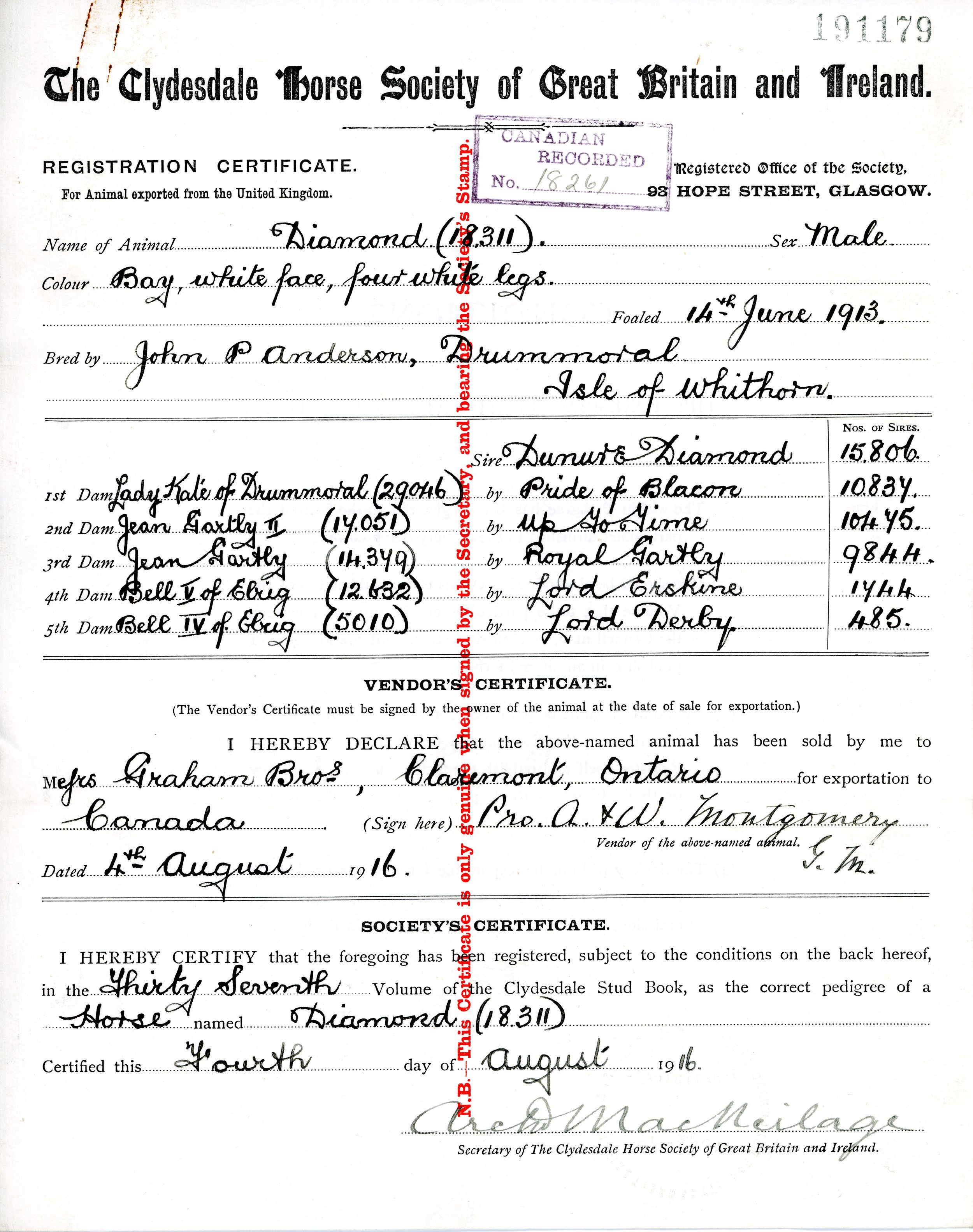
Registration Certificate with the Clydesdale Horse Society of Great Britain and Ireland for “Diamond”, owned by Lee Ford in the early 1920s.
2) Bovey Home Construction Photograph
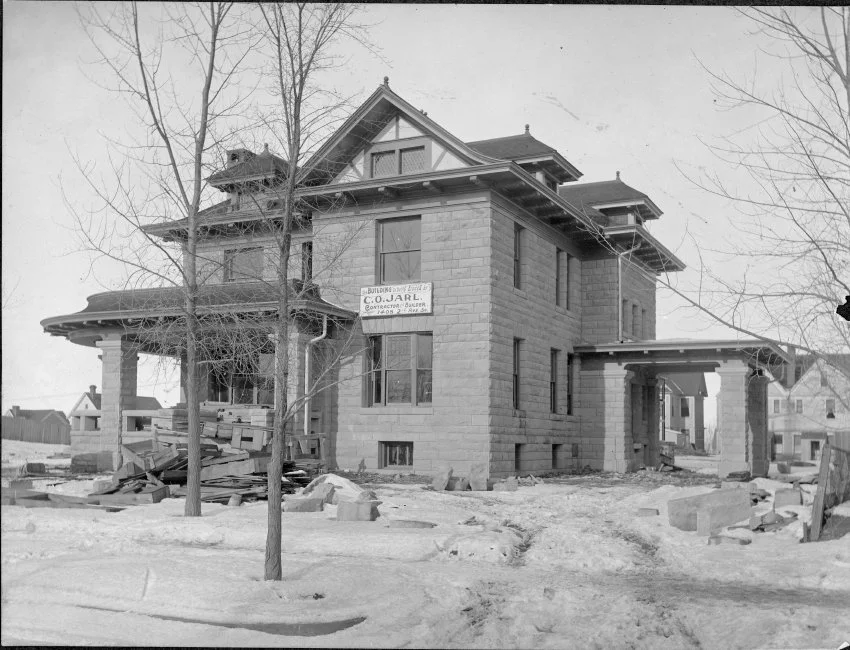
The Bovey home under construction with the sign “This building is being erected by C. O. Jarl. Contractor and Builder. 1408 2nd Ave South”, 1908. [1989.054.0516]
Built in 1908, the Bovey Home is of Period Revival architecture. The ashlar sandstone was quarried locally and features a large porch that surrounds the west and south sides. The covered driveway leads to a garage back against the alley. This photograph is unique because it gives us a rare look into the construction progress of a historic home in Great Falls. This beautiful home is part of the Lower Northside Residential district.
3) Arthur Gael Conrad Photograph

Portrait of Arthur Gael Conrad, 3 years old, leaning against a chair. A small toy elephant is placed on the chair. Photographer J. M. Moriarty. [THM 1989.054.0557]

Portrait of Arthur Gael Conrad, nicknamed “Taddy,” by W. S. Sutton, c. 1909. [CCHS 102.5]
This sweet baby boy passed away in April of 1909 of spinal meningitis. He was the son of Harfield Conrad and grandson to W. G. Conrad. His father had taken him to California in hopes of getting him better. The painting of him by W. S. Sutton was made from a studio portrait photograph by J. M. Moriarty. featured beside it. The painting was donated to our collection in 1977, and the photograph came to the collection through Sue Ford Bovey’s estate in 1989. Seeing them side by side is so wonderful. There is true tragedy that followed Arthur into death, which you can read more about here.
4) Letter from Katherine Edwards to Rachel Ford Campbell
Katherine Edwards was the only daughter of D. R. Edwards and was a world traveling socialite. The following is a letter from roughly November of 1935. Rachel Couch Ford had divorced Lee Ford in 1930 and recently married Alex Campbell, and they were off on a trip when she received this letter:
At Home – Tuesday Morning, [Nov] 1935
Our dear Rachel – So much water has passed under the bridge since your departure that I decided to use business paper in order to “get in”, at least, the “highlights” – Our own earthquake has occupied us rather seriously, for tho the tremors were slight, there was more or less damage done in various parts of town. On Thanksgiving morning at about 8:30 we experienced the most severe shake-up. Our house, so well built, and on a rocky ledge, shook and trembled from attic to basement. I am still terrified. All ornaments have been laid away, Dresden vases, and so on. In Helena, it is ten times worse than it has been here. The Earthquake, there, came with a tremendous roar. The Judge Pray’s went over and fetched the Calloway’s here. The judge and his wife – they were worn out from loss of sleep. The Irwin’s opened their camp at Lincoln where the two Calloway girls went with their children. The Calloway’s house was not damaged. The worst was on the East Side, among the poor people, as is usually the case.
Then, Mrs. Heisey died very suddenly, as you probably know, she had been ailing since last spring. At a bridge luncheon, it was given by Mrs. Anderson, I played with her, and she was tired out, but she loved going about and kept up to the last.
“They say” that she made quite an effort to collect a purse for the country club’s hostess, and phoned people repeatedly – every member – finally the men came to the rescue and the sum – a dollar donation from the two – 00 (hundred?) and sixty members was collected - $200 in all. I am quite sure that the hostess earned it – a trying position, which may, eventually lead to something worthwhile. She and her daughter seem to be constantly padding - well, we must do something in a small town – some “go in” for music, and some for art. I do wish that I were twenty years younger and had more talent and I would seriously devote my time to painting. Mrs. Lincoln is still striving? and manages to get a good deal of advertising, but I have no patience or faith, there, knowing her as well as I do.
Clara is studying under a Russian artist, he is far ahead of [Winold] Reiss, and Clara, will eventually come into her own. She also is frequently written up in the Tribune. Some sweet souls seem to thrive being in the limelight. The Tuesday Music Club has taken in a number of new members. At the first fall meeting the program was very find – piano duets, played by Mrs. Crow and Mrs. Trigg – all from memory – a truly entertaining performance. Alice Calvert was also on the program but was unable to sing – the audience, the few, there, were most enthusiastic. The newcomers gave the program at the last meeting- the Palm room was well filled, all the numbers were good, but not above the average.
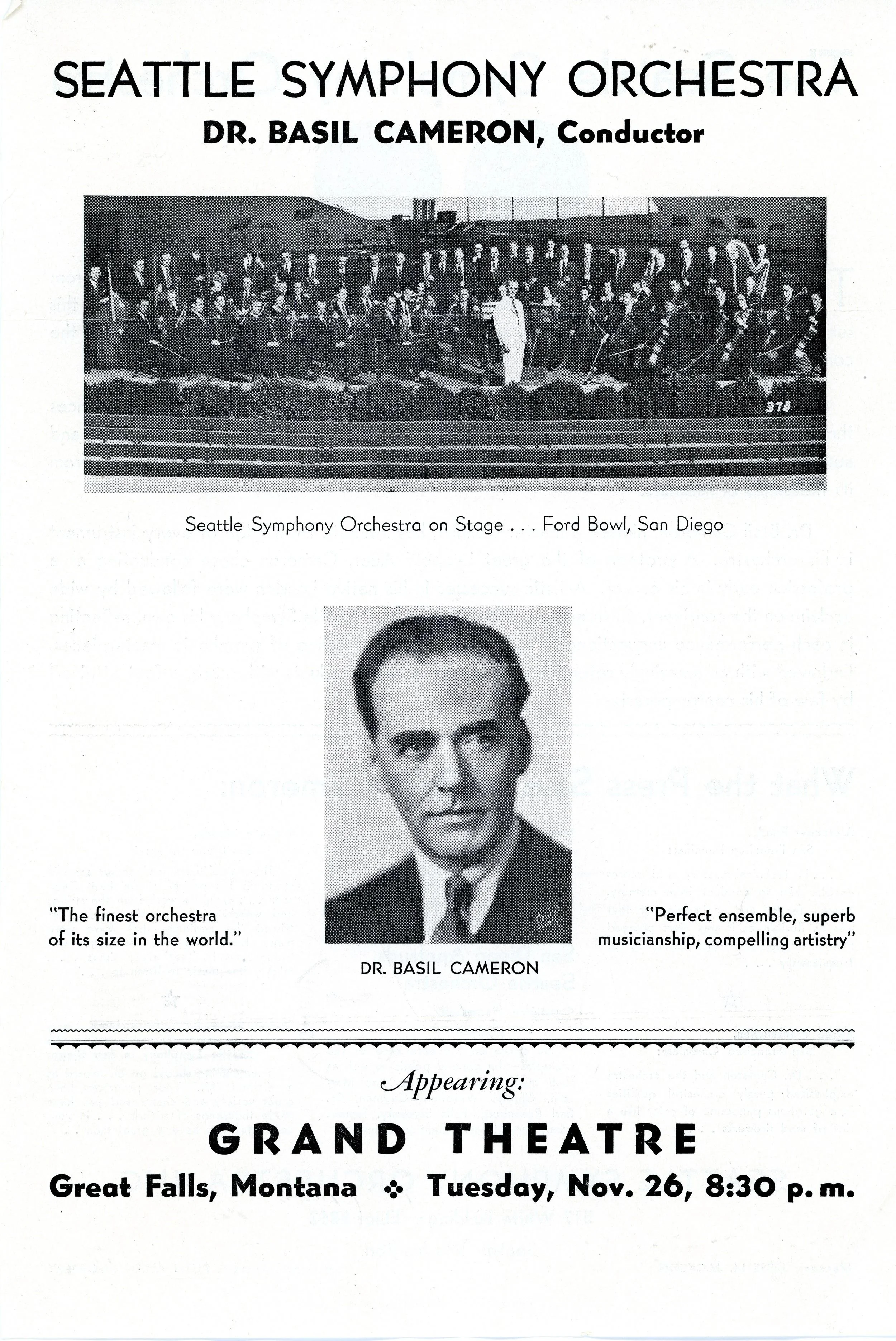
The Seattle symphony Concert was really wonderful. They played to a half empty house – Dr. Basil Cameron was furious, for he is a really famous man, and should have been better received. He gave no encore; “Great Falls will never be anything else than a middle-class smelter town and that’s that!” And with the unceasing wind and earthquakes I am quite ready to leave.
Attended the first dinner dance at the Country Club, Mrs. Harris? and I went out for a while. “All the World” seemed to be there.
Well, my own sweet friend. I have finally decided not to change my present mode of living. Romance came to me just about ten years too late. I am living serenely and very contentedly and just couldn’t “go thru with it.” So, I wrote him not to come in October, he was to have had his final answer then. I was afraid if I saw Virgil [?], that he might persuade me, for he is charming and very fine. Think I’ll adopt a chow dog for a companion! I am invited for luncheon so won’t begin another page. May I send Alex [Campbell] my love with yours? Katherine C. E.
5 & 6) Sue Ford’s Lamé Dress and Portrait
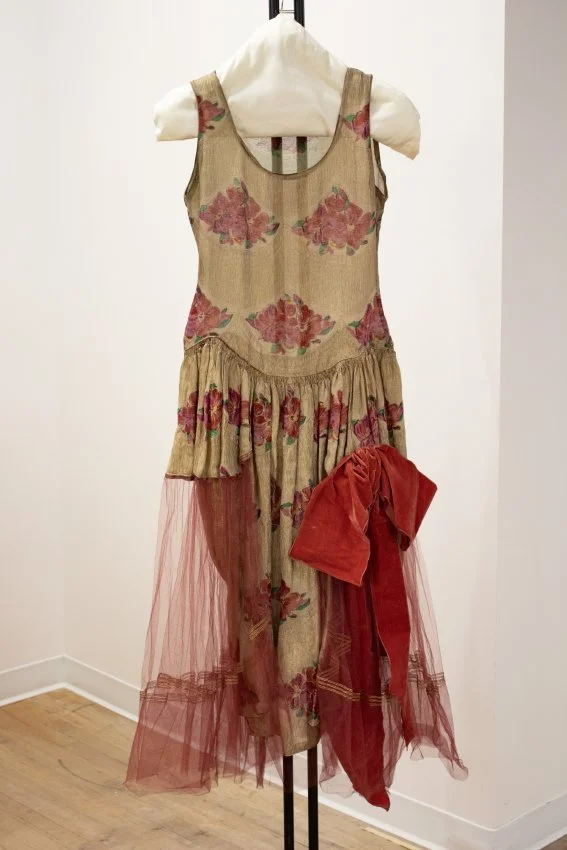
Sue Ford Bovey Dress, 1920s [1989.054.10]
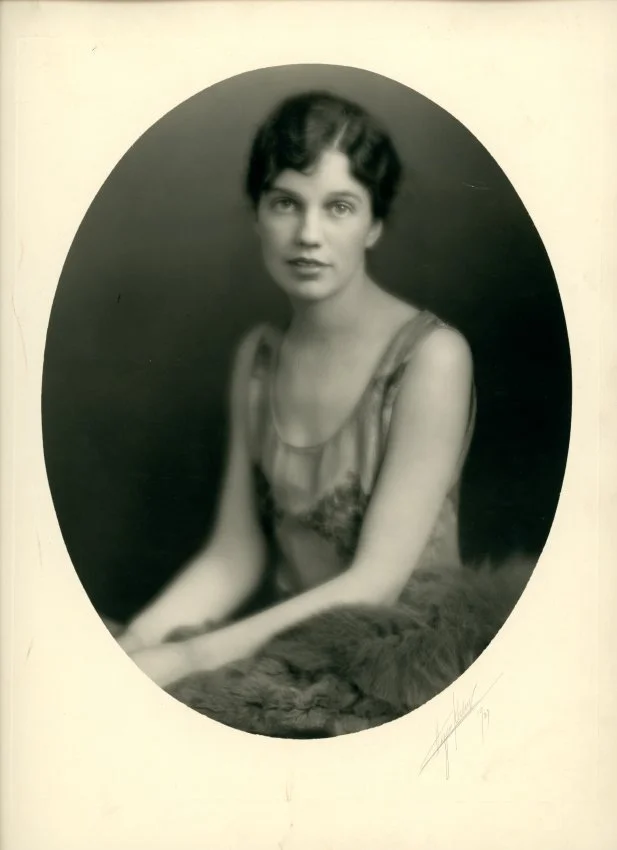
Portrait of Sue Ford [1989.054.0467]
Sue Ford Bovey’s dress and portrait of her wearing the dress is a rare treat for our photograph and clothing collection. Sue had the luxury of having many of her dresses custom made from fine fabrics. The dress shown here is made from a subtly textured woven gold/metallic lamé with printed floral design and fine netting. In the photograph, the slip skirt that would show under the netting is obscured (you can see it is slightly tucked into the main part of the skirt), and a large red velvet bow is on the wearer’s left. The dress is a late 1920s example, and after review from clothing conservator KayKarol Horse Capture, it has been discovered that the bow was a later addition to the dress. According to our records, this is the way the dress was donated to our collection in 1989, so it is unclear if Sue herself made this addition to the dress, or if perhaps it was modified by someone who needed something extra on the flapper dress from Sue to hit the town.
7) Lampshade Dress
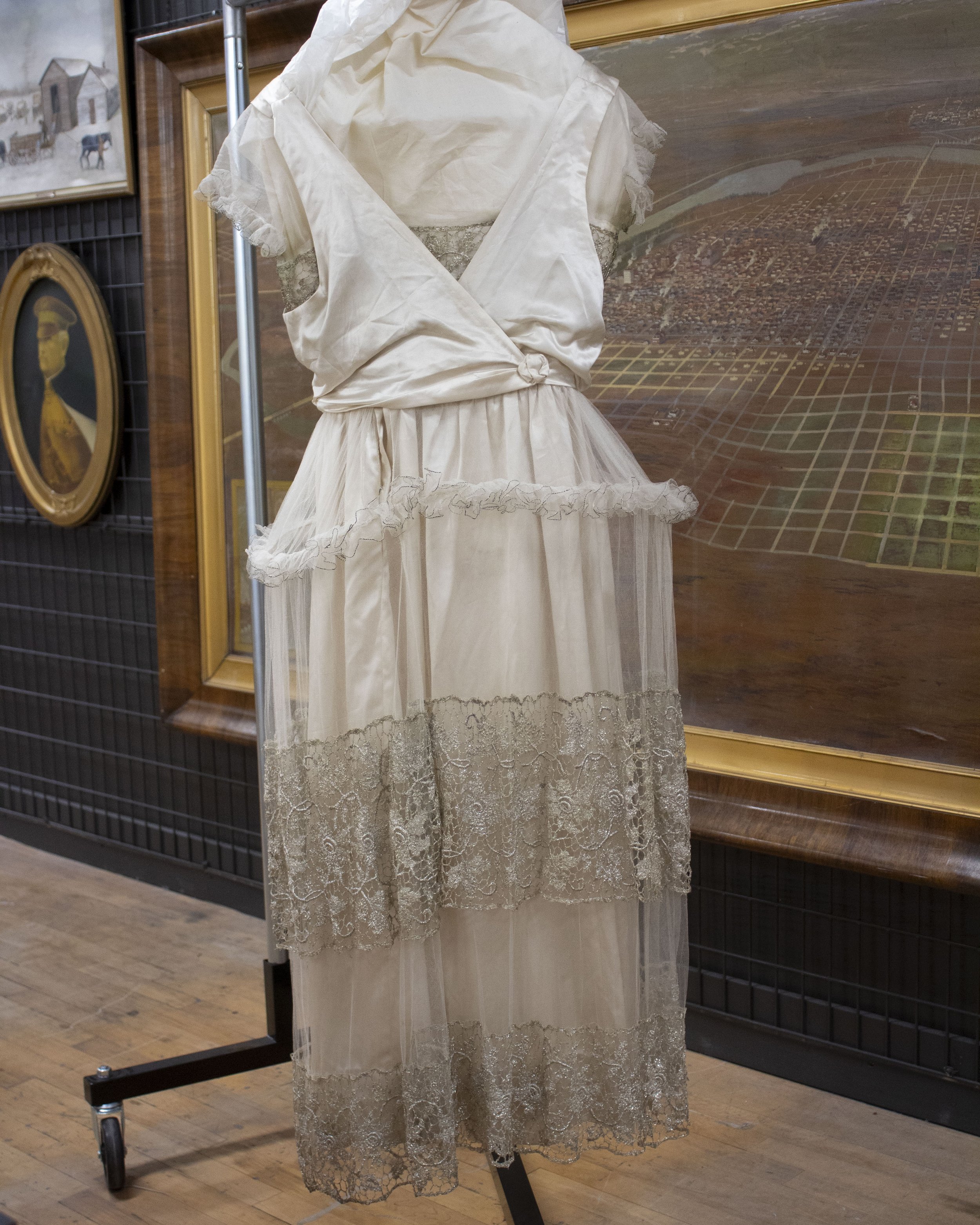
Sue Ford Bovey Lampshade Dress, 1910s [1989.054.7]
It’s difficult to feature only two dresses from Sue Ford Bovey’s collection, but this is one of the most unique dresses to our collection. The dress is made from a silk satin weave with silk tulle and silver lace panels on the bodice and skirt. The most intriguing feature is the metal hoop that extends the lace away from the body. The dress is in the style of designer Paul Poiret’s “lampshade” or Sorbet dresses, the first of which (1913) was made for a dancer in the Imperial Russian Ballet. An interesting detail are the dress shields sewn in the underarms branded “Golden West Japanese Silk.” Even Sue sweats!
8) Thomas Couch Jr. Drawings
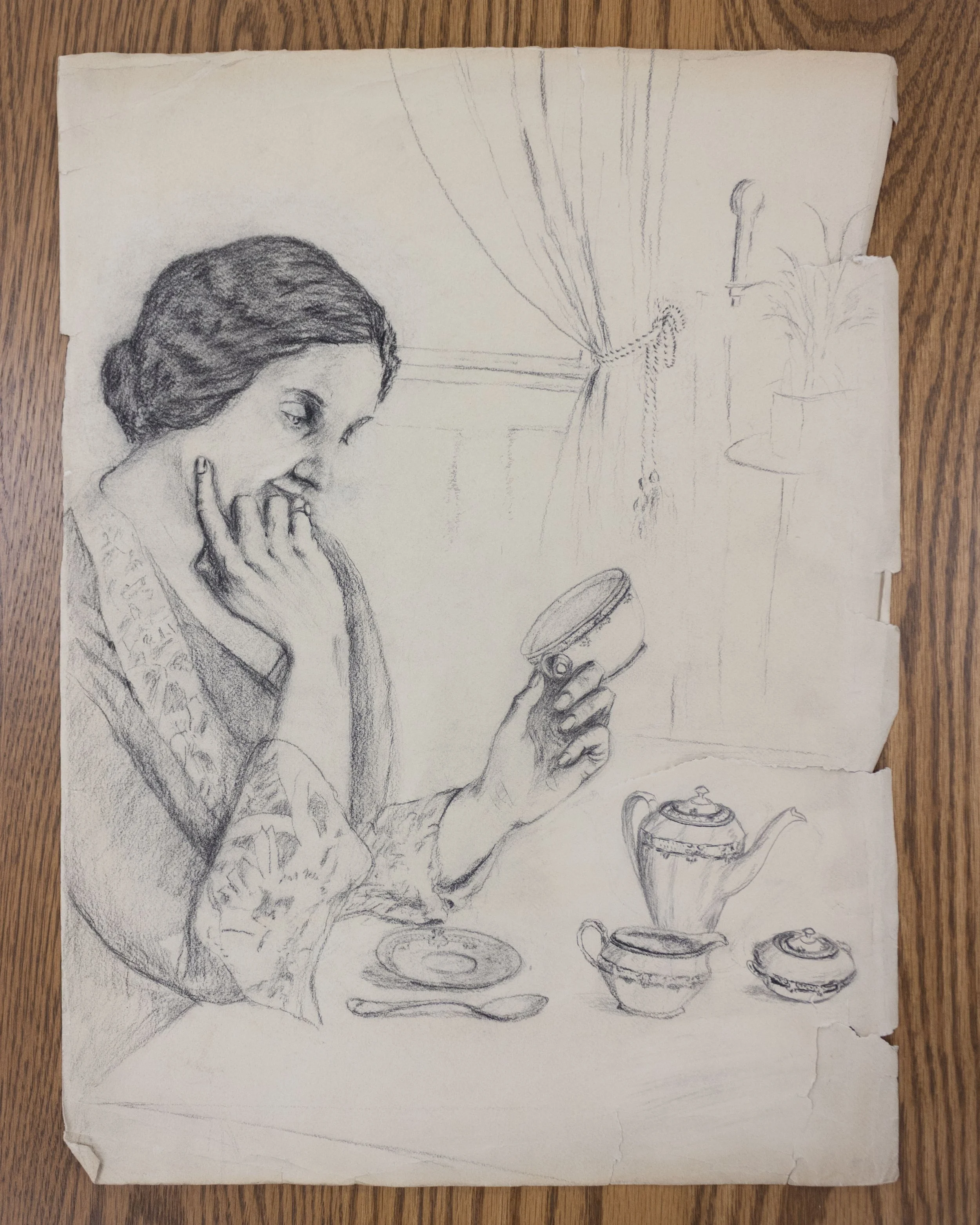
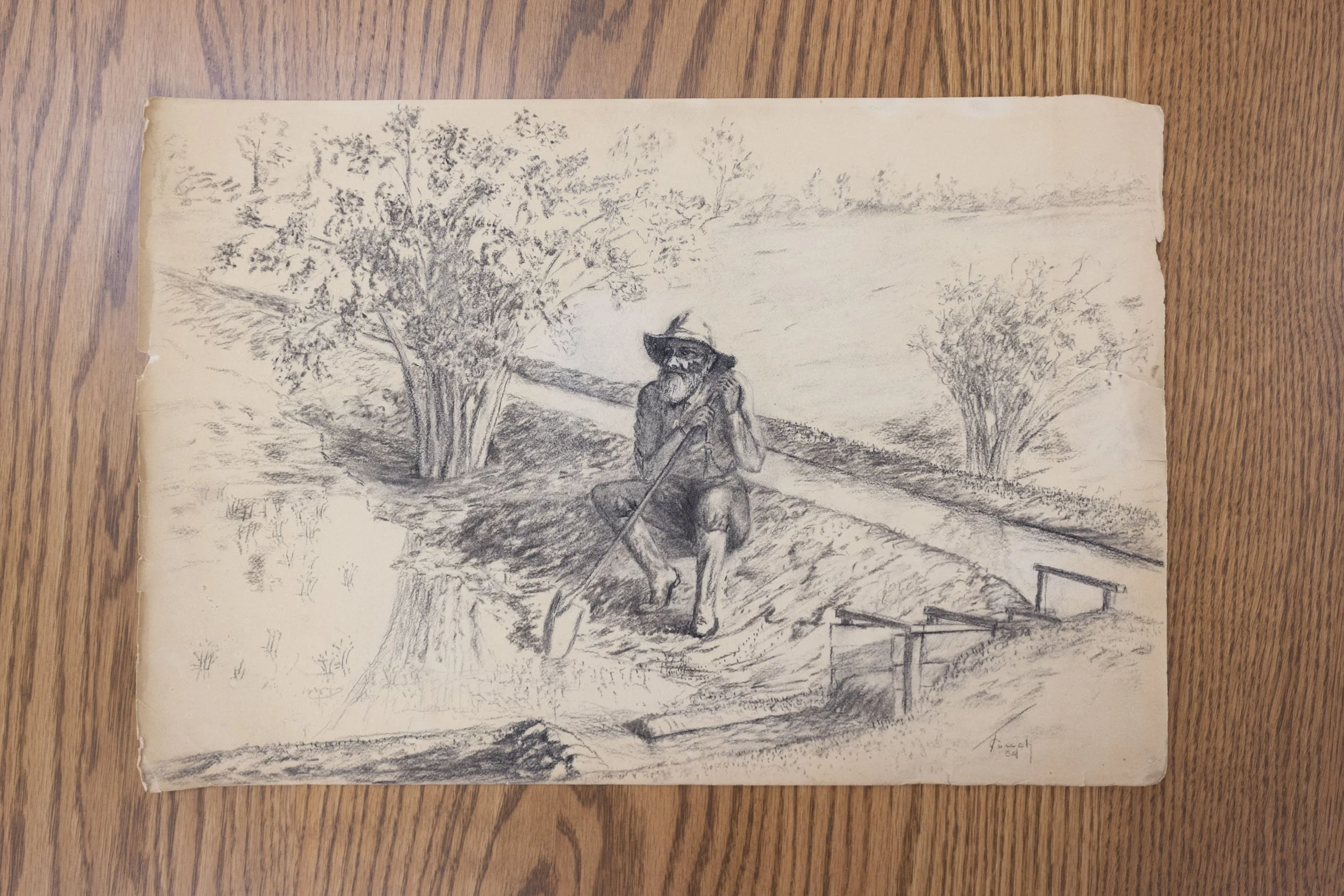
These two drawings made by Thomas Couch Jr. came from an anonymous source following the Sue Ford Bovey estate sale. The first is a portrait of Rachel Couch Ford in Palo Alto, California, as noted on the backside, and the second is an illustration of a prospector, dated 1934.
9) Charles Bovey’s State Senator Campaign Poster
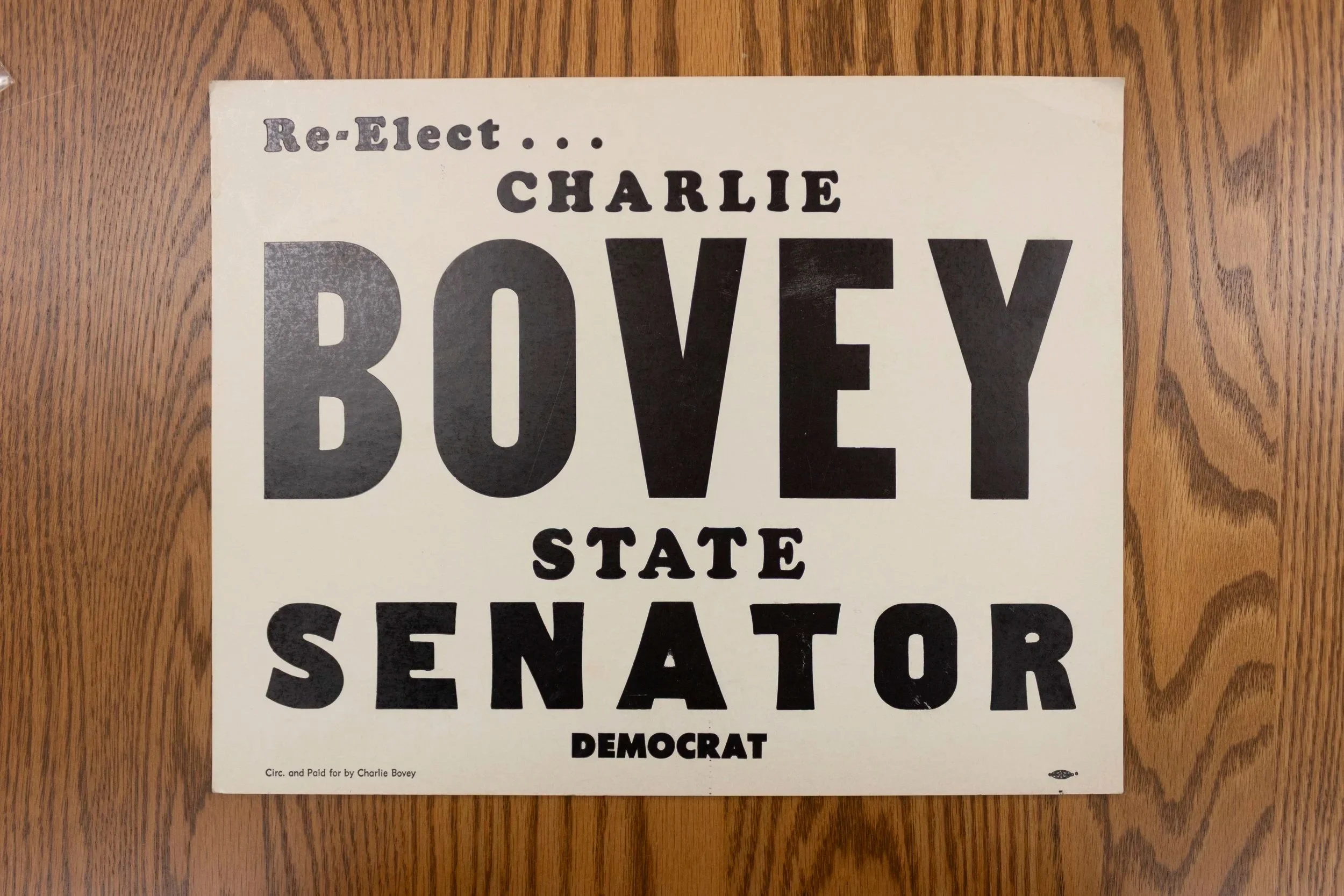
Charlie Bovey re-election sign for State Senator. [1989.126.1]
Charles entered politics in 1942, running as a Democrat for a Cascade County seat in the Montana House of Representatives. He won and served one term, then ran for the Montana Senate, where we again won and represented Cascade County until 1965. While elected, his focus was on welfare needs of the elderly and people with mental disabilities, as well as Montana’s historic preservation.
10) The Bovey Carriage
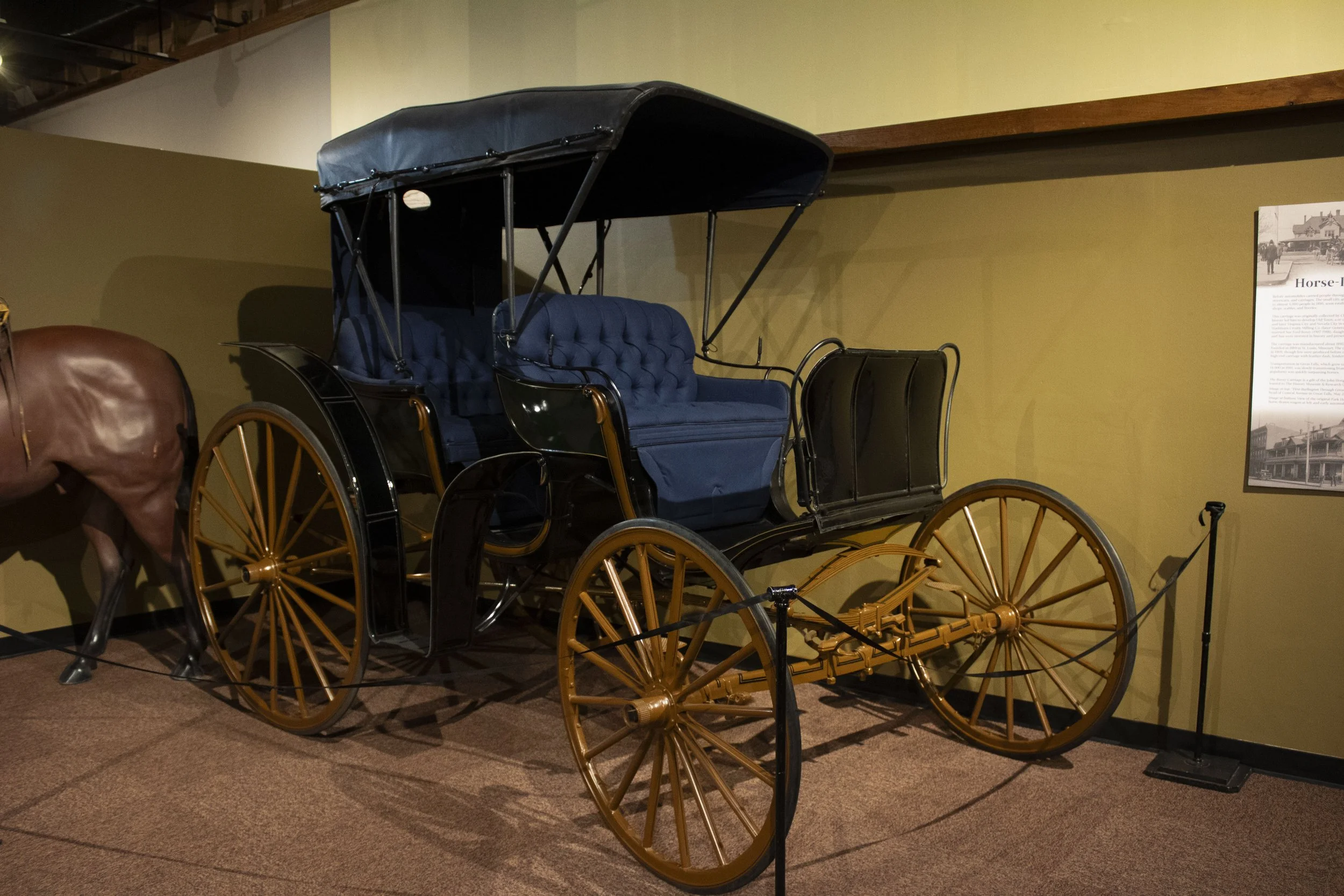
Bovey Carriage, gift of John and Shane Horgus Foundation. [2025.007.1]
This carriage was manufactured about 1895 by the Embree-McLean Carriage Company, which was founded in 1889 in St. Louis, Missouri. The company announced their transition to produce automobiles in 1909, though few were produced before the company went bankrupt in 1910. This model was a mid to high end carriage with leather dash, fenders with steps, and posts for oil burning lamps. It includes a hitch for a single horse or two (not shown). The Bovey Carriage is a gift of the John Horgus Estate in 2025, restored by David Watkins in 2007 and first loaned to The History Museum & Research Center in 2008.
Charles Bovey had an interest in collecting history and automobiles, which lead to an interest in collecting carriages, and then entire buildings. Together Charles and Sue developled Old Town, a re-creation of the 1880s at the Great Falls Fairgrounds in 1941, and later Virgina City and Nevada City in southwestern Montana. The carriage serves as not only an illustration of the horse-drawn years of Great Falls, but a glimpse of the historic endeavors of the Boveys.